


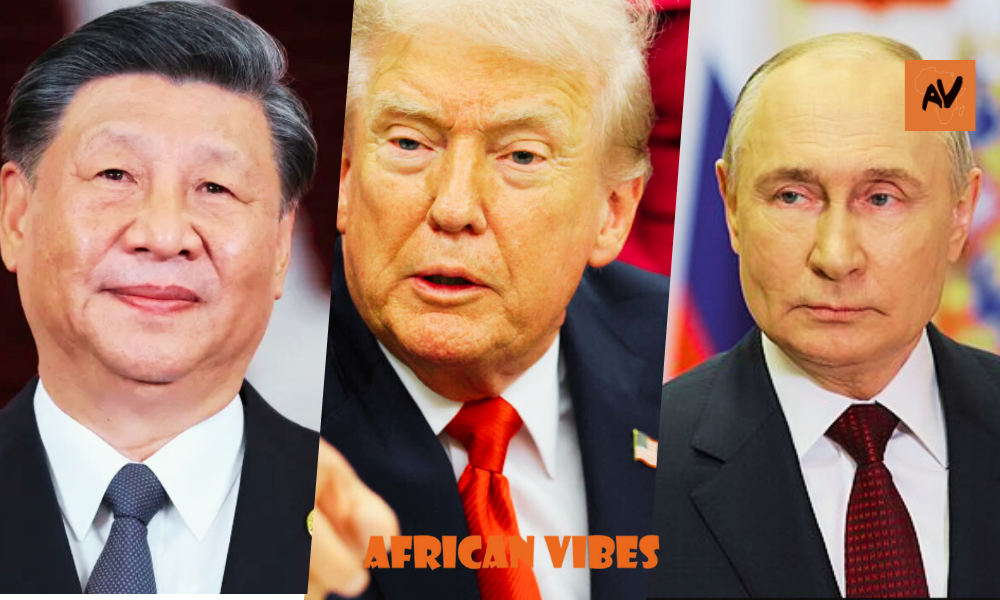
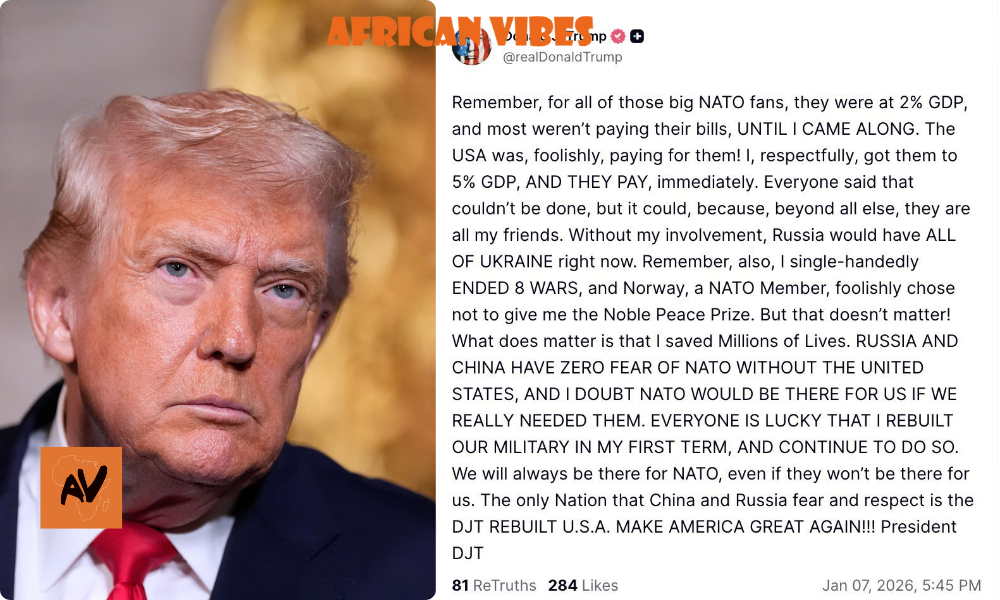
President-elect Donald Trump has never been subtle, and his latest warning about NATO is no exception. In a characteristically emphatic statement, he argued that without U.S. leadership, the alliance lacks credibility, asserting that Russia and China “have zero fear of NATO” without American power behind it.
While the remarks were aimed squarely at Europe and Washington’s allies, their implications extend far beyond the transatlantic arena. For Africa, Trump’s blunt assessment reflects a deeper global reality: the erosion of a U.S.-centered international order and the acceleration of a multipolar world in which African states are no longer peripheral spectators—but active stakeholders.
NATO’s Limits—and Africa’s Lessons
Trump’s critique underscores a long-standing truth: NATO’s deterrent power is overwhelmingly dependent on U.S. military, financial, and logistical support. This dependency has raised renewed questions about the alliance’s durability and political cohesion.
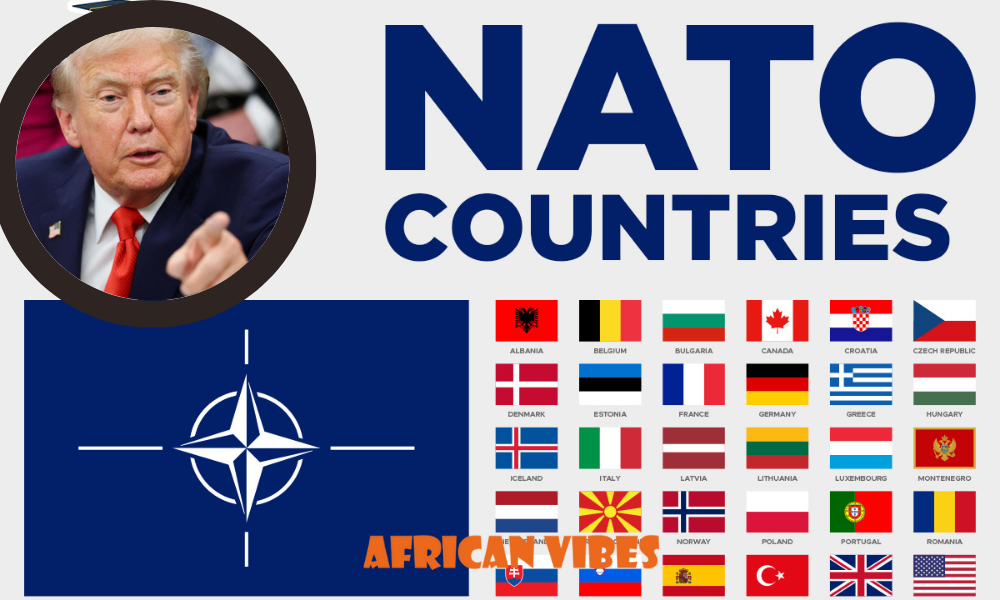
From an African perspective, such questions are not academic. NATO’s record on the continent—from the 2011 intervention in Libya to ongoing counterterrorism operations in the Sahel—has often left behind instability rather than durable peace. While Western officials frame these actions as security assistance, many African societies experience them as externally driven interventions misaligned with local realities.
At the same time, Western engagement has frequently been selective. Persistent crises—whether famine in the Horn of Africa or insurgencies across the Lake Chad Basin—rarely command sustained attention unless broader geopolitical interests are at stake. This uneven approach has fueled skepticism toward traditional security alliances.
ALSO READ: Why Trump’s Venezuela Move Struck a Nerve Across Africa
Russia and China’s Expanding Footprint
As Western influence wavers, Russia and China have moved decisively to expand their presence across Africa.
Russia has deepened ties with military-led governments in Mali, Niger, and Burkina Faso, offering security assistance—often through private military contractors—in exchange for access to strategic resources such as gold and uranium. China, meanwhile, has entrenched itself as Africa’s largest bilateral trading partner, financing ports, railways, and industrial zones under the Belt and Road Initiative.
These engagements are not without controversy. Debt sustainability concerns, particularly in countries like Zambia, and fears of overdependence are real. Yet many African governments argue that these partnerships deliver tangible infrastructure and respect national policy autonomy in ways Western aid frameworks often have not.
The reality is nuanced: neither Russia nor China is altruistic, but their willingness to engage on pragmatic terms reflects Africa’s growing leverage in a competitive global environment.
ALSO READ: Russia Troops in Burkina Faso: Ibrahim Traoré’s Security Pact With Putin
Africa Caught Between Power Blocs
A weakened NATO and intensifying great-power rivalry carry concrete risks for Africa. Global conflicts already reverberate across the continent. The war in Ukraine disrupted grain supplies, driving up food prices across Africa in 2022 and 2023. Rising U.S.-Russia tensions have contributed to arms proliferation in fragile regions, exacerbating instability and displacement.
Meanwhile, competition over critical minerals—cobalt, lithium, and rare earths—has intensified pressure on countries like the Democratic Republic of Congo, where global demand intersects with weak governance and social vulnerability.
Trump’s vision of a more assertive U.S. posture could further sharpen these rivalries, particularly as American security interests increasingly intersect with Chinese economic infrastructure on African soil.
A Strategic Path Forward
Yet Africa is not without agency. The African Continental Free Trade Area (AfCFTA), representing a market of 1.4 billion people and a combined GDP exceeding $3 trillion, offers a pathway toward economic integration and reduced external dependence.
To navigate the multipolar era effectively, African states must prioritize coordination over alignment. This means strengthening African Union institutions, negotiating resource partnerships that prioritize local value addition, and investing in youth-driven innovation across technology, energy, and security.
The goal is not isolation, but balance: engaging all major powers while subordinating external interests to continental priorities.
A Moment That Demands Choice
Trump’s warning about NATO may have been framed as American bravado, but it reflects a broader truth—the era of unquestioned Western dominance is ending. For Africa, this shift presents both danger and opportunity.
Whether the continent emerges fragmented or fortified will depend on its ability to act collectively, assert sovereign interests, and translate geopolitical competition into sustainable development.
History will not wait. Africa must decide whether to remain an arena for global power struggles—or become a power in its own right.