


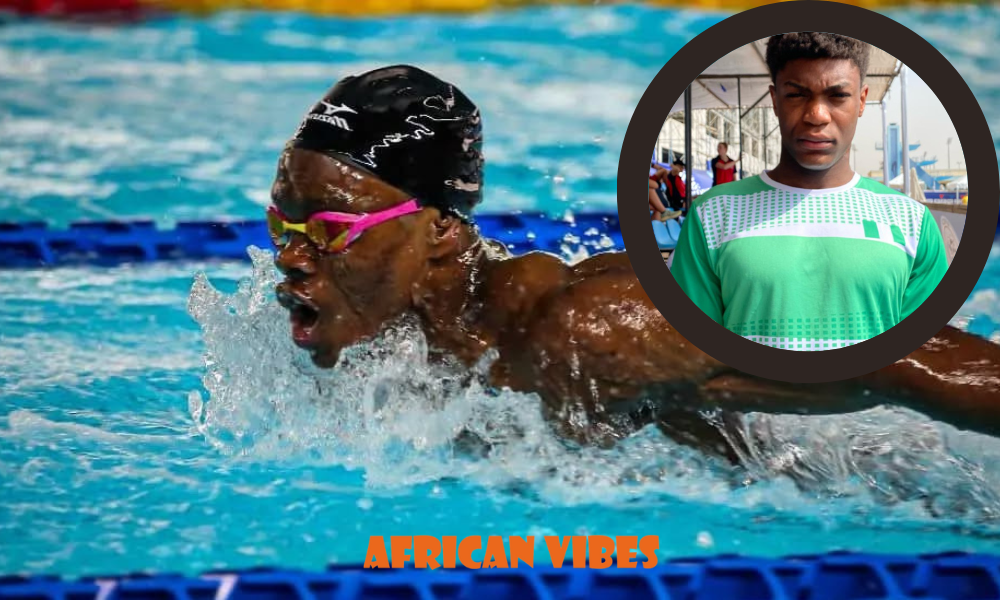
When Abdul Jabar Adama surged into the wall at the end of the men’s 50-meter butterfly final, the moment lasted barely 23 seconds. Its consequences, however, may reverberate far longer.
At the World Aquatics Junior Championships, the 17-year-old Nigerian swimmer captured silver, becoming the first athlete from Nigeria ever to win a medal at a World Aquatics event. For a country of more than 200 million people—one whose global sporting identity has long been shaped by football pitches and running tracks—the result marked an unexpected and transformative arrival in a sport where Nigeria has rarely figured.
Swimming, after all, is a discipline defined by access: to pools, to coaching, to international competition. Nigeria has had little of any. That reality made Adama’s podium finish not merely surprising, but quietly radical.
“This is history,” a Nigerian official said afterward. Few disagreed.
ALSO READ: David Munyua’s Historic Win Brings Kenya to the World Darts Stage
A Sprinter From the Margins
Abdul Jabar Adama does not come from a nation with a deep Olympic swimming tradition, nor from a system built to produce elite aquatic athletes. His rise has been gradual, shaped less by abundance than by adaptation.
Growing up in Nigeria, Adama trained in conditions that would be unfamiliar to many of his competitors—limited pool time, uneven facilities, and scarce international exposure. Progress required patience. Improvement required improvisation.
Still, those close to him noted something early: speed.
Butterfly sprinting, one of swimming’s most punishing events, rewards explosive power and technical precision in equal measure. Adama possessed both. By his mid-teens, he was producing times that hinted at international relevance. Coaches began to pay attention. So did competitors.
At the junior level, where talent is raw and margins are unforgiving, Adama’s performances stood out not because they were flashy, but because they were consistent.
“He was always there,” one observer said. “Always close.”

The Race That Changed the Conversation
The men’s 50-meter butterfly final unfolded with the expected intensity. Eight swimmers. One length. No room for correction.
Adama’s start was clean. His underwater phase was controlled. By the midpoint, he was already in contention. In the final strokes, he accelerated, holding off challengers from countries with far deeper swimming infrastructures.
When he touched the wall, the scoreboard confirmed what many in the arena had already sensed: Nigeria had won its first World Aquatics medal.
The race itself was fleeting. The symbolism was not.
| Event | Men’s 50m Butterfly |
|---|---|
| Competition | World Aquatics Junior Championships |
| Result | Silver Medal |
| Significance | Nigeria’s first World Aquatics medal |
Within minutes, images of Adama on the podium began circulating online, shared by World Aquatics and amplified across African sports networks. For Nigerian swimming, long relegated to the margins of international competition, the image carried unusual weight.
ALSO READ: Road To 2026 FIFA World Cup African Qualifiers
Why This Medal Matters
Nigeria’s relationship with swimming has always been complicated. Despite a vast coastline and a large youth population, the sport has struggled to gain traction. Funding has been inconsistent. Facilities uneven. International success, until now, nonexistent.
Adama’s silver does not solve those problems. But it reframes them.
It offers evidence that elite swimming talent can emerge from Nigeria, and that with sustained investment, such success need not be isolated. Already, officials within the Nigerian Swimming Federation are pointing to the medal as leverage in discussions about infrastructure and youth development.
Beyond Nigeria, the result resonates across Africa. Competitive swimming on the continent has been sporadic, often overshadowed by athletics and football. Adama’s performance joins a small but growing body of evidence that African swimmers can contend on the global stage when given opportunity.
The medal, in that sense, is less a culmination than a beginning.
What Comes Next
Adama remains junior-eligible, but his trajectory now points toward senior international competition. The transition will not be simple. The leap from junior success to Olympic relevance is steep, particularly in sprint events dominated by swimmers from the United States, Australia, and Europe.
Still, the path is clearer than it was a week ago.
Adama has spoken of ambitions that extend beyond junior championships—senior World Aquatics events, Olympic qualification, sustained international presence. Whether those ambitions are realized will depend as much on institutional support as individual discipline.
For Nigeria, the challenge is immediate and familiar: whether to treat this moment as an anomaly, or as an opportunity.
A Quiet Turning Point
There were no fireworks when Abdul Jabar Adama won silver. No anthem played. No grand declarations followed.
Just a teenager, standing on a podium, holding a medal that had never before belonged to his country.
In swimming, races are measured in fractions of seconds. But occasionally, one race alters a narrative years in the making. For Nigeria—and perhaps for African aquatics more broadly—this may have been one of them.