


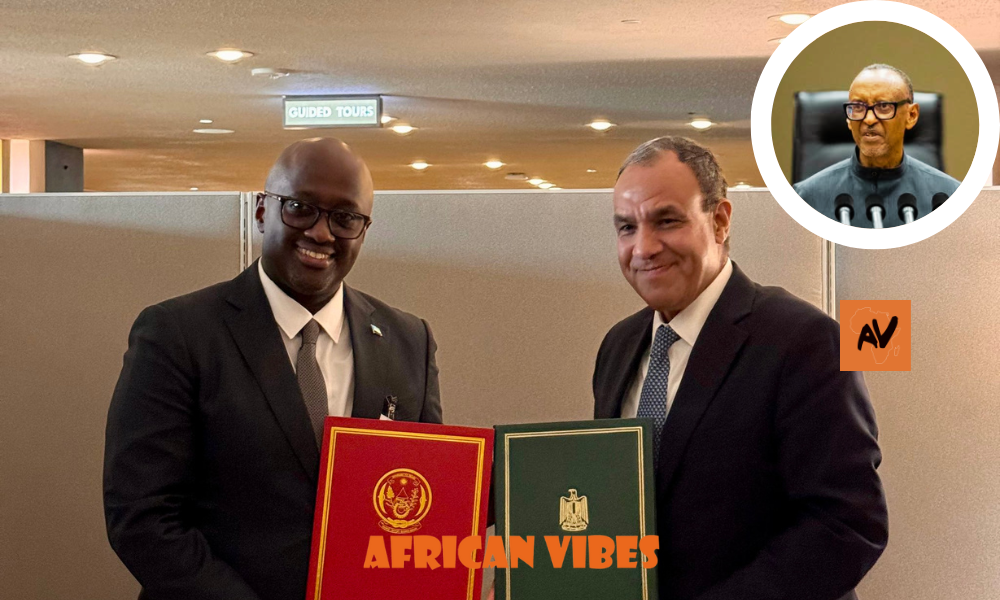
On 27 September 2025, two pivotal African capitals — Cairo and Kigali — drew one more link in the chain of continental integration. In a ceremony held on the sidelines of the United Nations General Assembly, Egypt and Rwanda signed a mutual visa waiver agreement for holders of diplomatic and official passports.
While limited in scope, the deal signals something much bigger than the administrative change: it is a symbolic and strategic stride toward a future of freer movement and deeper partnership across Africa.
In linking Cairo’s age-old cultural and industrial gravitas with Kigali’s youthful, tech-oriented dynamism, the two nations are forging a pathway for travel, trade and exchange that transcends old borders. For those who follow the arc of African progress, this is more than an agreement — it’s a statement.
The Road to Kigali and Cairo
The story begins with renewed engagement between Egypt — a long-standing hub of North African power and culture — and Rwanda, East Africa’s rising star of governance, innovation and economic ambition. In late September, Rwanda’s Minister of State for Regional Cooperation, Olivier Nduhungirehe, and Egypt’s Foreign Minister, Badr Abdelatty, formally signed the agreement
The move follows a high-level summit between Rwanda’s President Paul Kagame and Egypt’s President Abdel Fattah El‑Sisi earlier in September, where both leaders committed to deepening cooperation across investment, infrastructure, healthcare and trade.
Importantly, Rwanda has been one of Africa’s most open countries when it comes to travel. Citizens from many African states enjoy visa-free or visa-on-arrival access into Rwanda, positioning Kigali as a gateway to intra-continental mobility. Egypt’s move to reciprocate this spirit of openness—especially toward an East African partner—marks a strategic shift in policy and orientation for the North African power.
At a continental level, the agreement aligns with the vision of the African Union’s Agenda 2063: the creation of a borderless, integrated Africa where people, goods and ideas move freely.
ALSO READ: Burkina Faso Breaks Colonial Ties: Drops French as Official Language
Key Developments
Although the current pact covers only official- and diplomatic-passport holders, its implications are significant — particularly in two major domains:
A. Tourism and Cultural Exchange
Imagine an Egyptian embassy official easily travelling to Kigali to explore Rwanda’s famed gorilla-trekking tourism, or a Rwandan minister visiting Cairo to experience Egypt’s ancient monuments and burgeoning tech ecosystem — without visa hurdles. The agreement smooths the administrative friction that often retards cross-border travel.
By linking Cairo’s allure (pyramids, Nile cruises, Mediterranean tourism) with Rwanda’s ecotourism, innovation hubs and growing service economy, the bilateral accord promises to catalyse movement of not only officials but soon business travellers, entrepreneurs, cultural actors and tourists. It plants the seed for deeper people-to-people ties.
B. Trade, Investment and the Continental Marketplace
The real value of the treaty lies in what it enables behind the scenes: faster meetings, easier site visits, improved collaboration. Egypt sits at the crossroads of Africa, the Arab world and the Mediterranean; Rwanda is positioning itself as East Africa’s investment and technology hub. Their complementarity is evident.
By lowering travel barriers — even for a subset of travellers — Egyptian firms can more easily engage with Kigali’s emerging markets (agriculture, fintech, infrastructure), while Rwandan exporters and entrepreneurs gain streamlined access to one of Africa’s largest economies. It is a practical step toward the ideals encapsulated by the African Continental Free Trade Area (AfCFTA), which seeks to merge 55 economies into a high-growth intra-African trade zone.
Weaving the Continental Tapestry
This agreement may seem modest, but in the broader puzzle of African integration it holds outsized significance.
A. A Building Block for a Borderless Africa
The vision of visa-free movement across Africa is ambitious — and will be achieved not by grand proclamations alone, but by concrete bilateral and regional pacts such as this one. Egypt and Rwanda are laying a template for others: north meets east, two diverse economies linking, reducing travel friction and signalling trust.
Integration of North Africa—which has often been viewed as culturally and economically distinct—with East Africa’s dynamic growth trajectory is particularly meaningful. It sends a message: African progress is pan-continental, not regional fragments.
B. Strengthening the African Diaspora’s Connection
For Africans in the diaspora, the deal offers fresh optimism. Easier access means more opportunities to invest back home, visit family, engage in cultural or entrepreneurial exchange. It brings the continent a little closer, physically and symbolically.
Every time a visa barrier falls, the continent becomes more accessible to its own people — and to itself. That shift in mindset is as important as the ink on the agreement.
V. The People’s Perspective: From Diplomacy to Daily Life
Behind every treaty is a human story. Consider the Egyptian investor visiting Kigali to explore a start-up partnership in clean tech; or a Rwandan scholar attending a conference in Cairo without months of paperwork. Over time, travel becomes easier not only for ministers but for students, creatives, families and business makers.
The ease of movement fosters cultural exchange. Rwandan artists collaborate with Egyptian counterparts in a joint Cairo-Kigali arts residency; tourism operators bundle Nile-to-Volcano Trail itineraries; African diaspora families link roots in both countries faster than ever. These micro-stories scale into macro-impact.
Conclusion
The Egypt-Rwanda visa-waiver agreement is more than diplomatic handshake — it is a milestone for African connectivity. It shows what is possible when political will meets continental ambition.
But the path ahead is long. For the vision of a truly borderless Africa to materialise — from Cape Town to Cairo, Dakar to Dar es Salaam — more nations must follow. The momentum is there: bilateral deals, regional blocs, continental frameworks are converging.
To the leaders, business-builders and citizens of Africa: the challenge is clear. Let this landmark between Cairo and Kigali be the spark that ignites others. With each handshake, each stamp-free arrival, each cross-border investment, the continent’s future becomes not only imaginable — but imminent.