


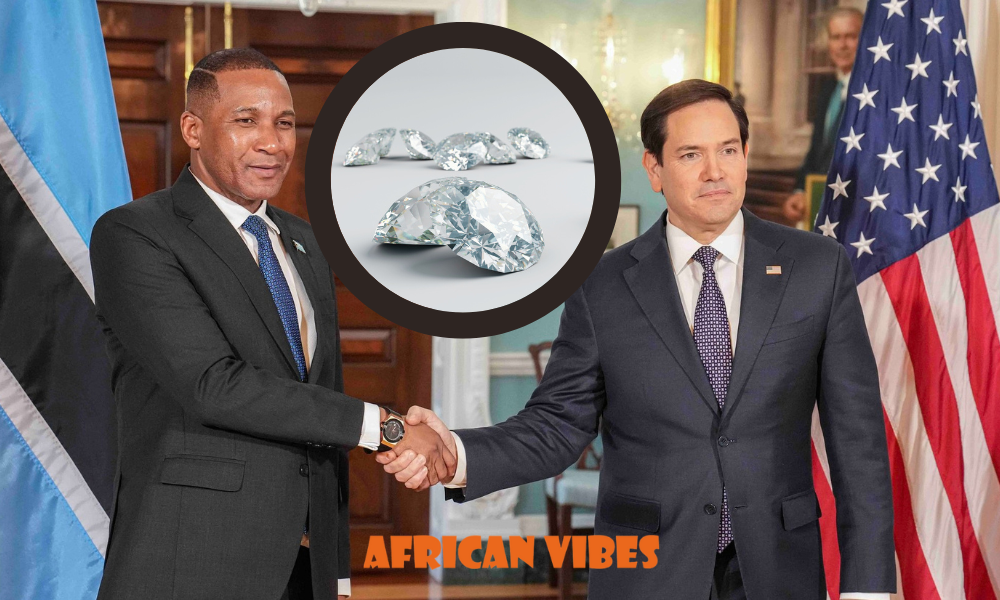
In the evolving theatre of US–Africa trade relations, a quiet revolution is taking shape — and its epicenter is Botswana, the world’s diamond powerhouse. Long hailed as Africa’s model of stability and sound resource management, the landlocked nation is now on the verge of finalizing a duty-free diamond agreement with the United States.
But this is far more than a trade pact. It is a bold statement of Economic Sovereignty, a declaration that Africa will no longer be content with exporting raw materials while others profit from their refinement. For Botswana, this deal represents both defiance and design — a strategic move to anchor itself in two powerful economies at once: the luxury market and the clean energy future.
I. The Diamond That Built a Nation
Few countries embody the transformative power of natural resources like Botswana. Since the discovery of its vast kimberlite deposits after independence in 1966, diamonds have powered its rise from one of the world’s poorest nations to a beacon of stability and prosperity.
Through prudent governance and a visionary 50/50 partnership with De Beers, known as Debswana, diamonds became the foundation of Botswana’s social contract — funding free education, world-class HIV/AIDS treatment, and modern infrastructure.
Today, diamonds still account for 80% of Botswana’s exports and nearly one-third of government revenue. Yet this success story now faces turbulence.
The post-pandemic slump in luxury spending, the meteoric rise of lab-grown diamonds, and a 37% US tariff on Botswana’s polished gems have all combined to strain the country’s economic model. For a nation so dependent on a single resource, this was more than a setback — it was an existential warning.

II. The Strategic Pivot: Gems for Geopolitics
President Duma Boko’s administration responded not with pleas for relief, but with a masterclass in strategic negotiation. Botswana proposed a zero-tariff agreement on diamonds cut and polished within the country — a direct reinforcement of its “Local Beneficiation” agenda.
This principle lies at the heart of Botswana’s development philosophy: keep the value at home. Instead of sending rough diamonds abroad for polishing, Gaborone wants American jewelers to buy directly from Botswana, where the full value chain — mining, cutting, and design — takes place.
But in diplomacy, leverage is everything. And Botswana found its ace in the green economy.
The Critical Minerals Card
In return for duty-free diamond access, Botswana has offered the United States priority access to its reserves of copper, nickel, and cobalt — minerals essential to electric vehicle batteries and renewable energy technologies.
This is a geopolitical masterstroke. It directly aligns with Washington’s quest for ethical, diversified supply chains outside China and the DRC, while giving Botswana a seat at the high table of the global energy transition.
By tying its legacy industry (diamonds) to its future industry (critical minerals), Botswana has created a dual-engine growth model — securing today’s prosperity while investing in tomorrow’s sustainability.
ALSO READ: Burkina Faso Breaks Colonial Ties: Drops French as Official Language
III. Economic Sovereignty in Action
If finalized, the deal would fundamentally reshape both Botswana’s economy and the architecture of US–Africa trade.
1. A Boost for Local Industry
A zero-tariff agreement would make Botswana’s polished diamonds 15% cheaper in the US market, instantly enhancing competitiveness against stones cut in India or Thailand. The ripple effects at home would be transformational:
- Job creation: More cutting and polishing plants mean more high-paying technical jobs for Tswana youth.
- Skills transfer: Expansion in diamond grading, laser cutting, and jewelry design.
- Increased national revenue: More value captured domestically means greater fiscal stability and funding for social programs.
2. A New Trade Model for Africa
This agreement signals a shift from traditional one-way trade deals like AGOA to a reciprocal, strategic partnership model. Instead of preferential access granted out of benevolence, this is value for value — ethical diamonds for critical minerals, stability for supply security.
ALSO READ: Niger Takes Full Control of Its Gold Mine from Australian Operator
3. Diaspora and Ethical Luxury
For the African diaspora and US consumers, this pact offers something deeper: ethical transparency. Botswana’s conflict-free diamonds, now directly accessible to US jewelers, can be marketed as symbols of African craftsmanship, empowerment, and integrity.
Diaspora-owned brands in the US could build entire collections around “diamonds from Africa, polished in Africa, profiting Africa.” It’s luxury with a conscience — and a clear origin story.
IV. Beyond the Sparkle: Diversifying the Future
Still, Gaborone understands that even the finest diamond cannot guarantee perpetual shine. The nation’s resilience will depend on diversification.
The Critical Minerals deal is not just a short-term bargaining chip; it is the cornerstone of a post-diamond economy. With American capital and technology entering the copper and nickel sectors, Botswana aims to become a regional processing hub for clean-energy materials.
Meanwhile, the government is investing diamond wealth into:
- Tourism: Promoting sustainable, high-end safaris across the Okavango Delta.
- Technology & Finance: Positioning Gaborone as a digital and fintech hub.
- Agriculture: Advancing water-efficient systems to enhance food security and exports.
This holistic vision underscores that Botswana’s true wealth is not beneath its soil — it’s in its strategy.
Conclusion: Africa’s Blueprint for Self-Reliance
As Botswana edges closer to sealing its historic deal with Washington, the symbolism is impossible to ignore. In a world where African nations are often treated as suppliers of raw materials, Botswana is rewriting the rules — asserting not dependency, but diplomatic parity.
This agreement is more than a trade victory. It is a declaration of African self-determination, proof that good governance and smart negotiation can outshine even the brightest gemstone.
Botswana’s sparkle is no longer just in its diamonds — it’s in its diplomacy. And as the continent watches, it may well mark the dawn of a new African era: one defined by resilience, reciprocity, and rightful reward