



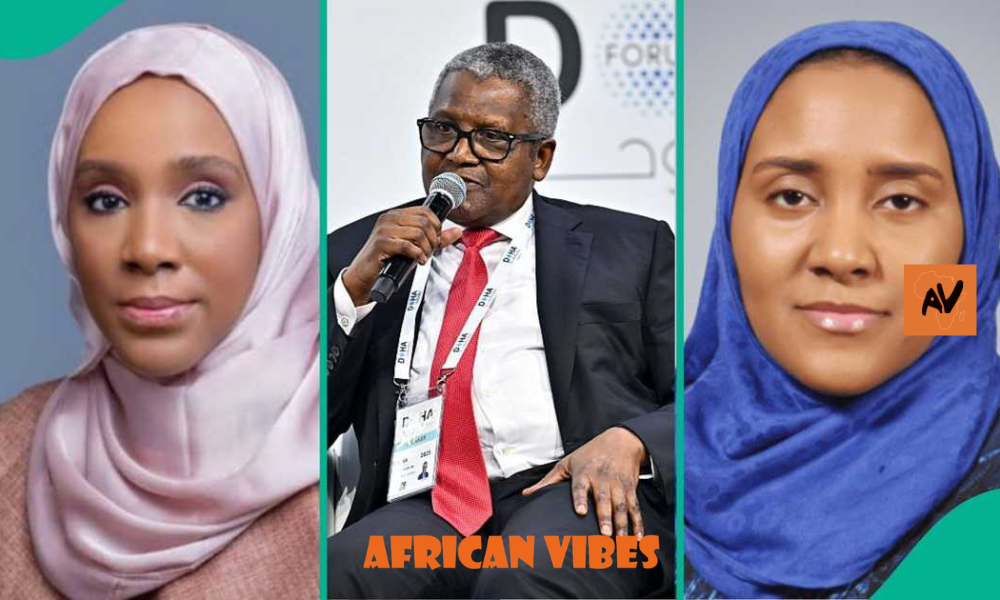
Africa’s richest man, Aliko Dangote, has officially appointed his daughters to senior leadership positions within the Dangote Group, marking a significant moment in the conglomerate’s corporate history and signaling what many see as the beginning of a structured succession plan.
The move places Halima, Fatima, and Mariya Dangote at the helm of critical divisions across the group’s global, oil and gas, cement, and food operations — pillars of one of Africa’s largest business empires.
This development represents not just a family transition, but a strategic recalibration of leadership at a time when the Dangote Group continues to expand both within Africa and internationally.
Halima Dangote to Lead Family Office and International Offices
Halima Aliko Dangote will head the Dangote Family Office and International Offices, with a strong focus on overseeing expansion efforts in Dubai.
This role is particularly strategic as the Dangote Group increases its global footprint. Dubai, known as a gateway between Africa, the Middle East, and global financial markets, offers a powerful platform for international investments and partnerships.
Her leadership signals the group’s intent to strengthen cross-border operations while maintaining centralized family governance.
Fatima Dangote Takes Charge of Oil and Gas Operations
Fatima Aliko Dangote will oversee Oil and Gas operations, including the Dangote Refinery and petrochemicals.
This appointment is especially significant given the scale of the Dangote Refinery — one of the largest single-train refineries in the world and a transformative project for Nigeria’s energy sector.
With Nigeria long dependent on fuel imports despite being a major crude oil producer, the refinery represents a pivotal shift toward domestic refining capacity. Fatima’s role places her at the center of one of Africa’s most consequential industrial ventures.
Mariya Dangote to Manage Commercial Operations for Cement and Foods
Mariya Aliko Dangote will oversee commercial operations for the group’s Cement and Foods divisions, with a focus on market growth.
Dangote Cement remains Africa’s largest cement producer, operating across multiple African countries. Meanwhile, the foods division continues to dominate segments such as sugar, flour, and salt production.
Her leadership in commercial strategy could play a decisive role in driving market expansion, competitive positioning, and regional growth across the continent.
A Structured Succession Plan in Motion?
While no official statement frames these appointments as a succession strategy, industry observers see clear signals of generational transition.
Family-led conglomerates across Africa and globally often face challenges during leadership transitions. By placing his daughters in operational roles rather than symbolic positions, Dangote appears to be institutionalizing governance continuity.
This structured approach could ensure stability across the group’s diverse portfolio — from cement manufacturing to energy infrastructure.
ALSO READ: From Producing Cement To Owning The Largest Single-train Refinery In The World
A Milestone for Women in African Corporate Leadership
The appointments also represent a broader milestone for female leadership in Africa’s corporate ecosystem.
With women still underrepresented in executive roles across major African conglomerates, the elevation of Halima, Fatima, and Mariya Dangote sends a powerful message about gender inclusion at the highest levels of business.
Their leadership may inspire broader conversations around women’s participation in strategic industrial sectors such as oil and gas, heavy manufacturing, and global finance.
A New Chapter for the Dangote Legacy
Aliko Dangote’s decision to entrust key divisions of his empire to his daughters marks the beginning of a new chapter for the Dangote Group.
As the conglomerate navigates global expansion, refinery operations, and continental market growth, this generational shift may define the future trajectory of Africa’s largest privately held industrial empire.
The Dangote legacy, built over decades of strategic investments and industrial scale, now appears poised for its next era — one shaped by a new generation of leadership.