


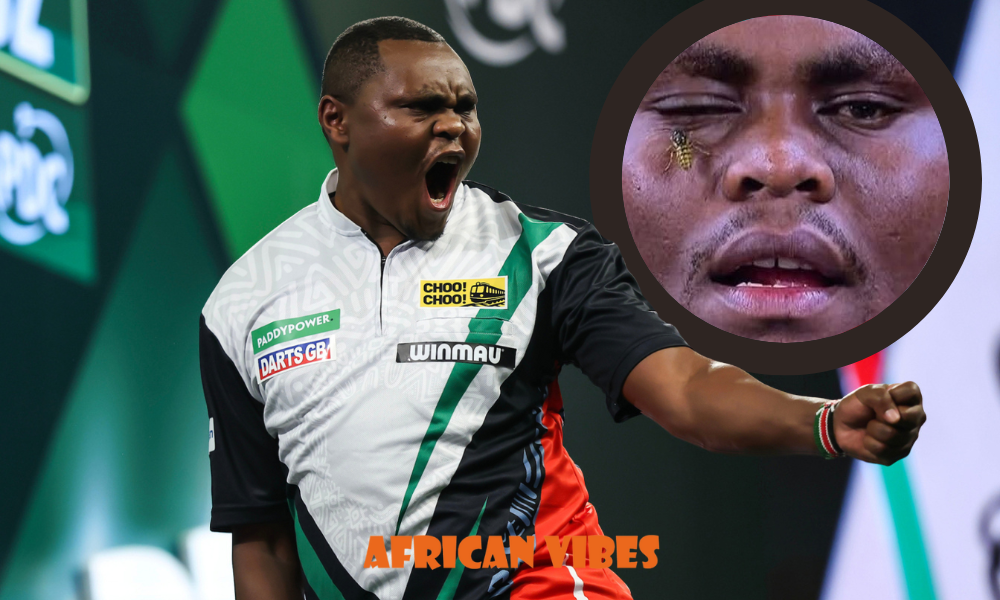
When David Munyua stepped onto the Alexandra Palace stage on December 18, he carried no national precedent with him. No Kenyan had ever won a match at the PDC World Darts Championship, the sport’s most prestigious tournament. By the time he left the stage, history had been made.
David Munyua, a 30-year-old veterinarian from Murang’a County, overturned a two-set deficit to defeat Mike De Decker, the world No. 18, in a gripping first-round match that unfolded with the unpredictability of sport at its most human. The final score — 3–2 — only hinted at the improbability of the achievement.
There were missed darts, sudden momentum swings, a curious interruption involving a wasp, and ultimately a sequence of throws that demanded uncommon calm. A 135 checkout, finished on the bullseye, steadied the contest. A double 20 ended it.
For Kenya, and for African darts more broadly, the result marked a threshold crossed — a quiet sport, long dominated by Europe, suddenly touched by a new geography.
ALSO READ: African Marathon Runners Shine at the 2025 Paris Marathon
A Life Split Between Livestock and Competition
Away from the spectacle of Ally Pally, Munyua’s life is far removed from television lights and roaring crowds. He works full-time as a veterinary doctor, tending to livestock and rural communities in central Kenya. Darts fits into the margins of his schedule, practiced in spare hours, often without access to professional infrastructure.
His route to London was forged locally. He won the Kenya Open in Nakuru, then advanced through the African Darts Group Qualifiers in Nairobi, earning his place at the World Championship as the first African to qualify through that pathway.
Even his equipment spoke to the realities of his journey. Munyua competed at Alexandra Palace using borrowed darts, a quiet detail that stood in contrast to the sponsorship-laden kits of many of his opponents. It was not a disadvantage that defined his performance.

How the Match Turned
De Decker, a seasoned competitor, appeared to have the match under control after claiming the first two sets. Munyua struggled early, missing key doubles and conceding ground with visible frustration.
The third set marked a change. Munyua slowed the pace, recalibrated, and closed it out with a double 5 finish — an unglamorous number that nonetheless reopened the contest. In the fourth set, a brief interruption — a wasp landing near the stage — disrupted play and, unexpectedly, the rhythm of the match.
David Munyua handled the moment with composure, removing the distraction and drawing cheers from a crowd that had begun to sense an upset. Momentum followed. The match moved to a deciding set.
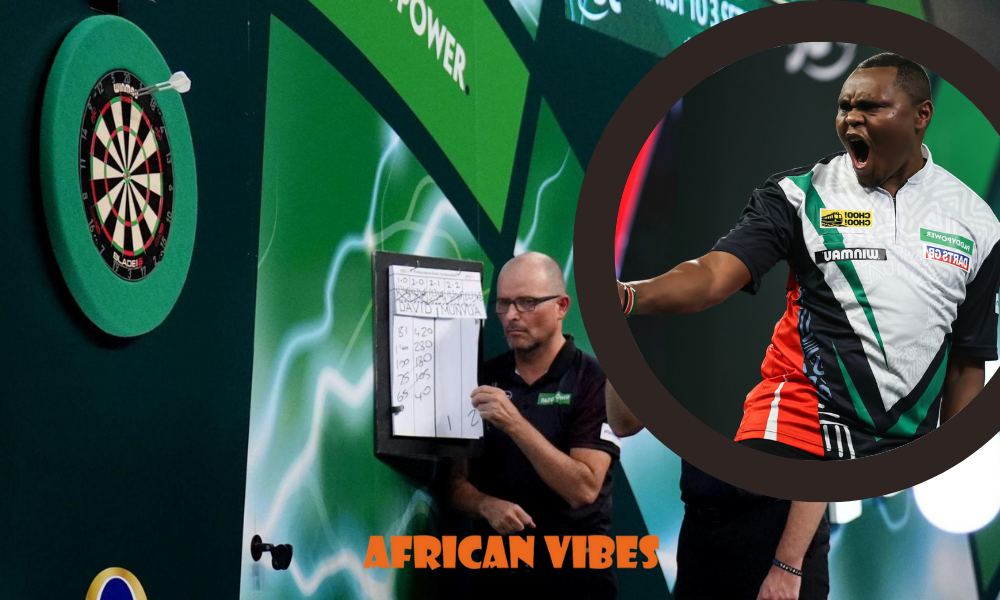
There, under the heaviest pressure of his career, David Munyua produced his finest darts. The 135 checkout, capped by a bullseye, was both technically difficult and emotionally stabilising. Moments later, on his fourth match dart, he hit double 20.
The arena responded with disbelief and applause.
What the Win Represents
By winning his opening match, David Munyua secured £15,000 in prize money, a significant sum in a sport where opportunity is often dictated by geography and access. He also earned global exposure, with broadcasters such as the BBC and Sky Sports highlighting his performance.
More importantly, the victory altered perception. Darts has rarely featured prominently in African sporting narratives, yet Munyua’s presence — and success — challenged assumptions about where elite competitors can emerge.
His win resonated widely in Kenya, where social media and local news outlets quickly embraced the story. For younger players across the continent, it offered something more durable than celebration: visibility.
ALSO READ: Road To 2026 FIFA World Cup African Qualifiers
The Road Ahead
Munyua will return to the Alexandra Palace stage on December 20, where he is set to face the winner of Kevin Doets vs Dennant in the second round. Whatever follows, the first barrier has already fallen.
Reflecting on the moment, Munyua kept his words measured.
“This is a big moment for Africa, for Kenya, and for darts,” he said.
It was not an overstatement. For a sport built on precision and patience, progress often arrives quietly — one dart at a time. On Thursday night in London, David Munyua threw one that landed far beyond the board.