


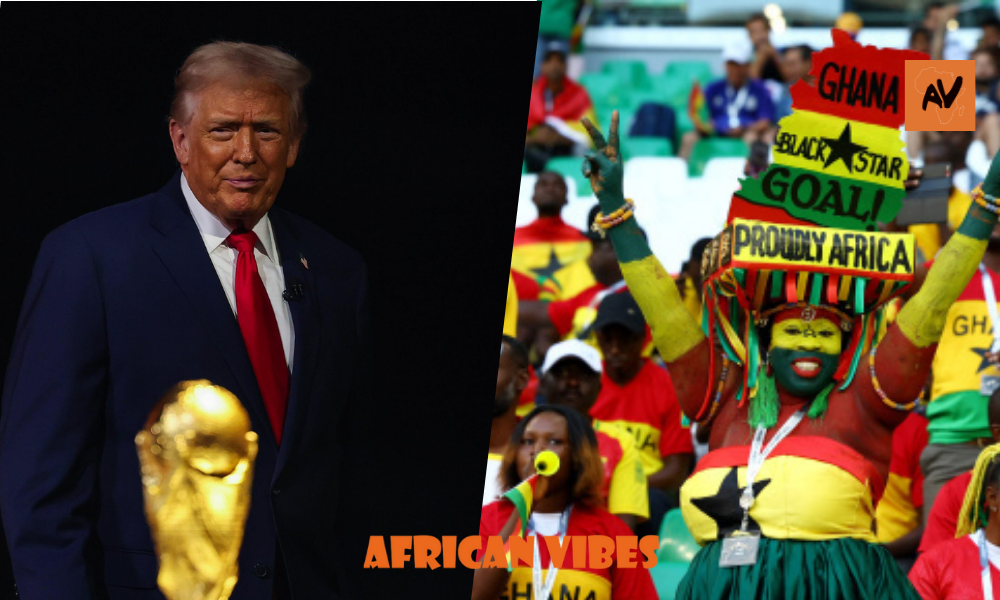
In 2026, the World Cup will arrive in the United States draped in the familiar language of openness: global unity, shared joy, the beautiful game without borders. On the pitch, African teams will be welcomed—Senegal’s discipline, Morocco’s tactical intelligence, Nigeria’s irrepressible flair. But in the stands, something will be missing.
Many of the fans who give African football its rhythm, color, and emotional voltage may never make it past the visa counter.
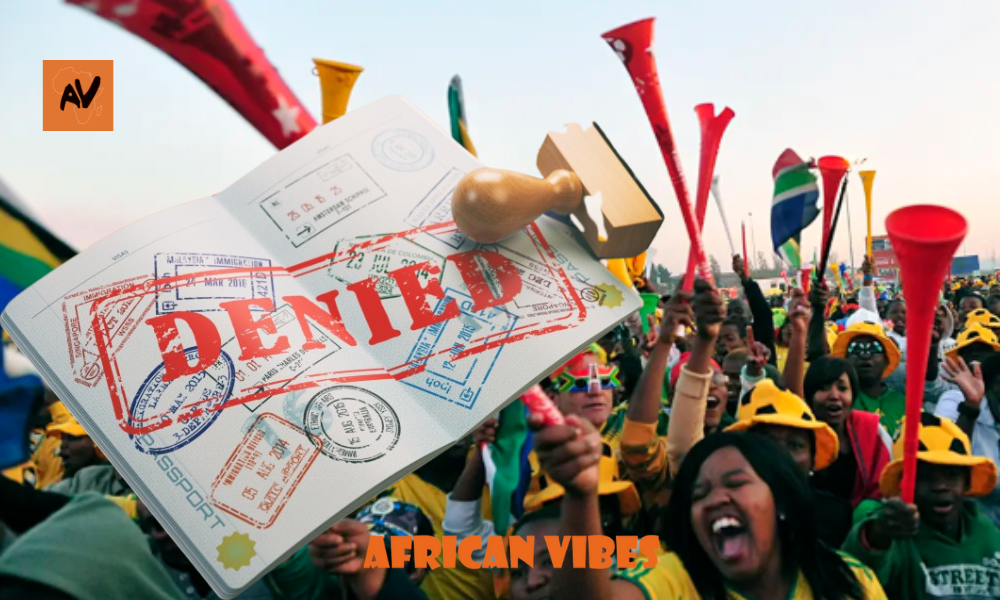
This is not a hypothetical concern. For supporters across Nigeria, Kenya, Ghana, Senegal, South Africa, and beyond, the prospect of attending the World Cup in the United States collides with a sobering reality: some of the world’s highest tourist visa rejection rates, long processing delays, and an immigration system that treats entire regions as presumptive risks.
The result is a quiet contradiction at the heart of the 2026 tournament. African players are welcome to perform. African fans, less so.
ALSO READ: Africa’s Final Qualifiers Set for FIFA World Cup 2026
A Game of Paperwork, Not Football
The American visitor visa process is famously discretionary. Applicants must prove “strong ties” to their home countries—steady income, substantial savings, clear travel histories—while convincing a consular officer, often in a brief interview, that they will return home.
For many African fans, this standard is structurally stacked against them. Informal economies dominate employment. Salaries may not be reflected in neat bank statements. Travel histories are limited not by desire, but by cost and historical mobility restrictions.
The statistics tell part of the story. In recent years, tourist visa denial rates for several African countries have hovered between 40 and 60 percent—dramatically higher than those for Europe or parts of Asia. The message, implicit if not explicit, is clear: some passports are trusted more than others.
For a global tournament built on the idea of universal belonging, that imbalance matters.
What the World Cup Loses
This is not merely an African grievance. It is a World Cup problem.
African supporters are not background noise; they are cultural infrastructure. From vuvuzelas and sabar drums to choreographed chants and flag-waving sections that turn stadiums into living theaters, African fans help define the spectacle of international football.
Their absence would be felt not only emotionally, but economically. Host cities stand to lose tourism revenue from a continent of more than a billion people. Airlines, hotels, restaurants, and local businesses lose customers. Players lose the visceral support that turns matches into memories.
And the tournament loses credibility.
A World Cup where fans from wealthy nations travel freely while others are filtered out by bureaucracy risks reinforcing a hierarchy the sport claims to transcend.
Visas and the Long Shadow of Inequality
Visa regimes are not neutral instruments. They reflect global power structures—who is presumed mobile, who must prove innocence, who is treated as a potential overstayer before they ever board a plane.
For many Africans, the experience of applying for a U.S. visa echoes older patterns: movement controlled, intent questioned, opportunity rationed. It is difficult not to see a throughline from colonial-era restrictions to modern border policies dressed in technocratic language.
This has consequences beyond sport. When African professionals, artists, students, and fans encounter repeated barriers to entry, the signal is internalized: participation is conditional, belonging is partial.
That message undermines the very idea of a “global” World Cup.
ALSO READ: A Historic First: Three East African Nations Team Up for AFCON 2027
What Could Be Done—And What Still Might Be
There are precedents for flexibility. Major sporting events have prompted temporary visa facilitation in the past, including expedited processing, special fan categories, or limited-duration waivers.
FIFA, which profits enormously from African talent and audiences, has leverage it rarely uses. African governments, acting collectively rather than individually, also have more bargaining power than they often deploy. Diaspora communities in the United States are already preparing informal alternatives—fan hubs, cultural houses, neighborhood watch parties—to recreate the atmosphere that visas may deny.
Still, mitigation is not the same as inclusion.
If the United States is serious about hosting the world, it must confront the optics and ethics of selective welcome. And if global football is serious about equality, it cannot ignore who gets stuck outside the gate.
The Match Beyond the Match
In 2026, Africa will show up. Its players will run, tackle, score, and celebrate on the biggest stage in sport. Its influence will be undeniable.
The question is whether the tournament’s hosts will allow the people behind that passion to share the moment in person—or whether the World Cup will once again reveal that while the pitch may be level, the world beyond it is not.
A truly global game deserves truly global access. Anything less is not just a policy failure—it is a failure of imagination.