


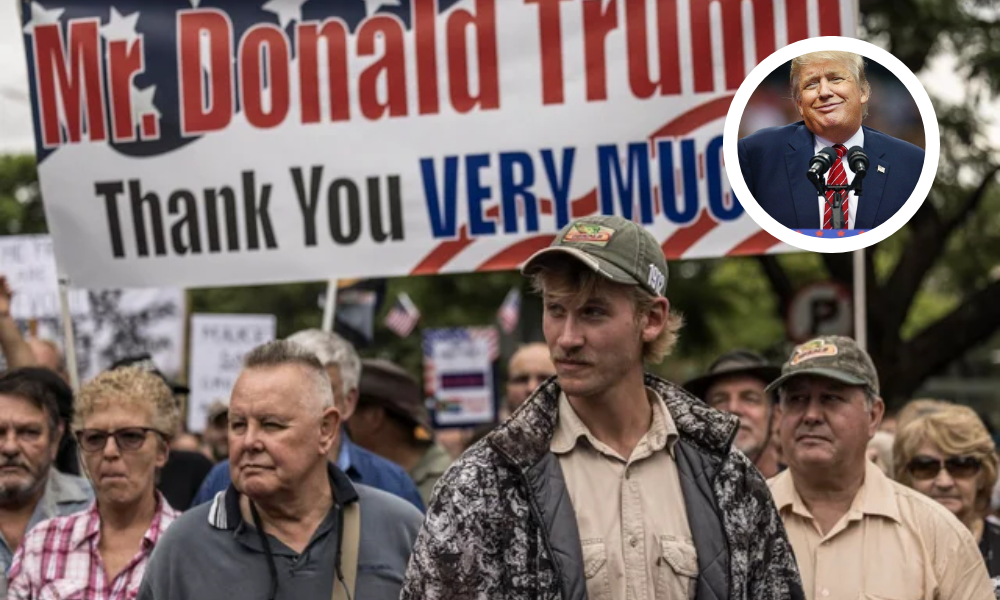
The air was brisk at Dulles International Airport as a chartered jet taxied to a quiet corner of the tarmac. Onboard: 59 white South Africans, primarily Afrikaners, many clutching suitcases and personal belongings.
As the doors opened, they were met not by anonymity, but by flashbulbs, State Department handlers, and carefully prepared welcome packets. Their arrival marked the first wave of migrants under a controversial executive order signed by President Donald Trump, granting refugee status to white South Africans on grounds of racial persecution.
ALSO READ: Ukraine Crisis: Racism, Neo Nazis, and African Government Response
This unusual migration has ignited fierce debates over race, refugee policy, and America’s moral compass. For some, it is a humanitarian rescue. For others, it’s a stark emblem of selective sympathy, made visible in the red carpet treatment these refugees have received.
A Presidential Order With Political Roots
In February 2025, Donald Trump signed an Executive Order, which directed the State Department to “immediately process and admit” white South Africans who could demonstrate “threat of racialized violence, expropriation, or targeted state discrimination.” The move was widely seen as a nod to Trump’s right-wing base, which has long rallied around the claim that white South Africans—especially farmers—are victims of state-sponsored racism.
The president cited a “genocide against white farmers,” a claim popularized in 2018 by conservative pundits and repeatedly debunked by human rights monitors and South Africa’s own statistics agency. Yet the rhetoric persisted, and with the 2026 elections looming, Trump’s refugee gesture seems carefully calibrated for political payoff.
Critics argue that the order is not only racially motivated but also strategically crafted to provoke cultural division and consolidate nationalist support ahead of the electoral season.
Who Are These Refugees?
Many of those who arrived this week come from rural provinces in South Africa. A significant number are farmers who claim they faced threats under South Africa’s land reform policies. Others are from suburban enclaves but argue that affirmative action and anti-white sentiment made life untenable.
While some cited specific incidents of violence or economic marginalization, legal analysts note that their claims often fall short of the standard refugee definition set by the 1951 UN Convention. Most had not sought internal relocation, nor had they applied for asylum elsewhere.
Observers also note that Afrikaners remain among South Africa’s most economically advantaged groups. Land redistribution, while controversial, has not resulted in mass expropriations without compensation. Indeed, South Africa’s Constitutional Court has repeatedly affirmed that any land reform must respect legal and due process norms.
Rolling Out The Red Carpet
Their arrival stands in stark contrast to that of most refugees. The 59 individuals were flown on a government-chartered Boeing 737. They were greeted by Deputy Secretary of State Christopher Landau and escorted to temporary housing coordinated by the Department of Homeland Security.
Resettlement plans include stipends, legal assistance, and fast-tracked employment placement—a level of support rarely extended to refugees from conflict zones like Sudan, Syria, or Haiti. Notably, the Episcopal Migration Ministries declined participation, stating, “We will not aid a policy that prioritizes whiteness under the guise of humanitarianism.”
Advocates for refugee equity point out that thousands of asylum seekers from Africa, Latin America, and the Middle East languish in detention or face deportation. “This is not about justice; it’s about optics,” said Fatima Ahmed of the Center for Refugee Equity. “It’s telling who gets welcomed with open arms and who gets turned away.”
South Africa Pushback
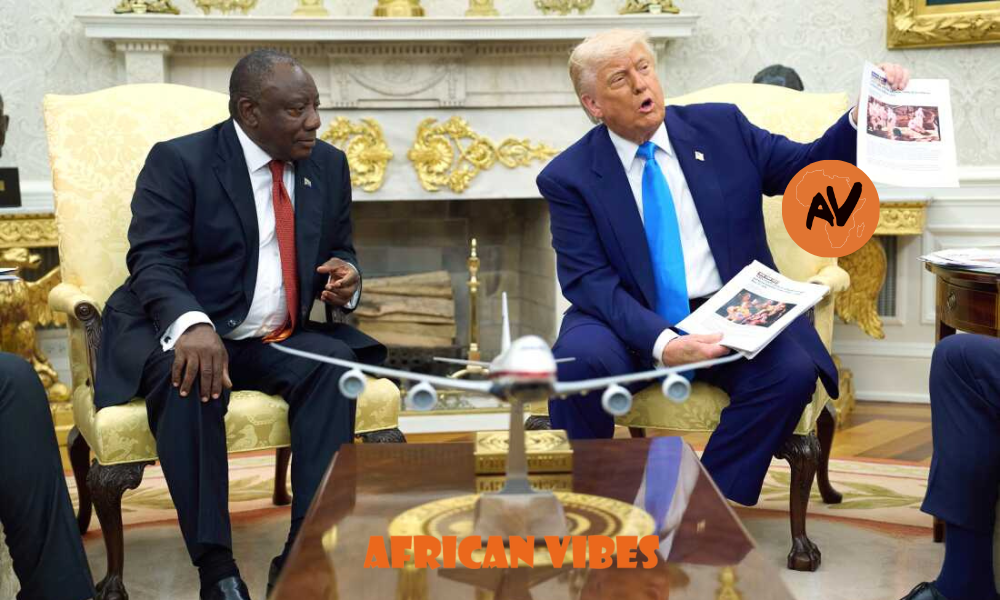
South African officials have denounced the U.S. program as racially biased and diplomatically reckless. President Cyril Ramaphosa’s spokesperson issued a statement: “There is no legal basis to treat any South African citizen as a refugee. South Africa remains committed to democracy, rule of law, and non-racialism.”
The Department of International Relations and Cooperation (DIRCO) accused the Trump administration of interfering in domestic policy for ideological ends. “This is not refugee protection. It is political theater, and it undermines our sovereignty,” said DIRCO Minister Naledi Pandor.
Fallout and Fractures
The program has already strained U.S.-South Africa relations. A planned bilateral trade summit has been postponed indefinitely. The African Union has requested clarification from Washington, warning that the move could set a troubling precedent.
Domestically, civil rights organizations have condemned the double standard. “We’re witnessing the weaponization of refugee policy to serve racial and political agendas,” said Sherrilyn Ifill, senior counsel at the NAACP Legal Defense Fund. “It calls into question the integrity of America’s asylum system.”
Meanwhile, some members of the South African diaspora in the U.S. expressed mixed feelings. “It’s hard to reconcile,” said Musa Kgosana, a Johannesburg-born educator based in Atlanta. “My cousin is still fighting for a student visa, and these folks get housing on arrival?”
What This Means for Africa’s Place in U.S. Policy
The episode has opened a wider and more urgent conversation about Africa’s role and dignity in global politics—particularly within U.S. foreign policy. Experts argue that this selective resettlement signals a troubling return to Cold War-era paternalism, where Africa is treated not as a sovereign equal but as a tool of ideological convenience.
“This shows how Africa is still used as a canvas for U.S. domestic politics,” said Dr. Blessing Moyo, a professor of African Studies at Howard University. “It reinforces the idea that African suffering only matters when it aligns with Western narratives.”
Increasingly, however, Africans are rejecting this dynamic. Recent protests in Mali and across West Africa following the attempted assassination of President Traoré are just one example of a growing Pan-Africanist consciousness—a collective refusal to be seen as expendable or subordinate. Moves like the preferential resettlement of white South Africans, which many perceive as racially motivated, are likely to deepen that resolve and further polarize global race relations.
As the Trump administration hints at expanding the program, the question remains: Is America prepared to defend a refugee policy that many in Africa and beyond are now viewing through a lens of racial hierarchy and political expedience?
A Tense New Chapter
For now, the Afrikaner families are settling into communities in Texas, Idaho, and the Carolinas. Their journey from South Africa to the U.S. has been swift and state-supported. But it may not be smooth. Protests are planned in several resettlement cities.
One refugee, identified only as Hendrik, told reporters: “We are grateful. We pray we can start a new life here.” Yet his arrival raises larger questions that America cannot afford to ignore.
In the words of commentator Thuli Madonsela, “History is watching. And it will remember who we rolled the carpet out for.”