


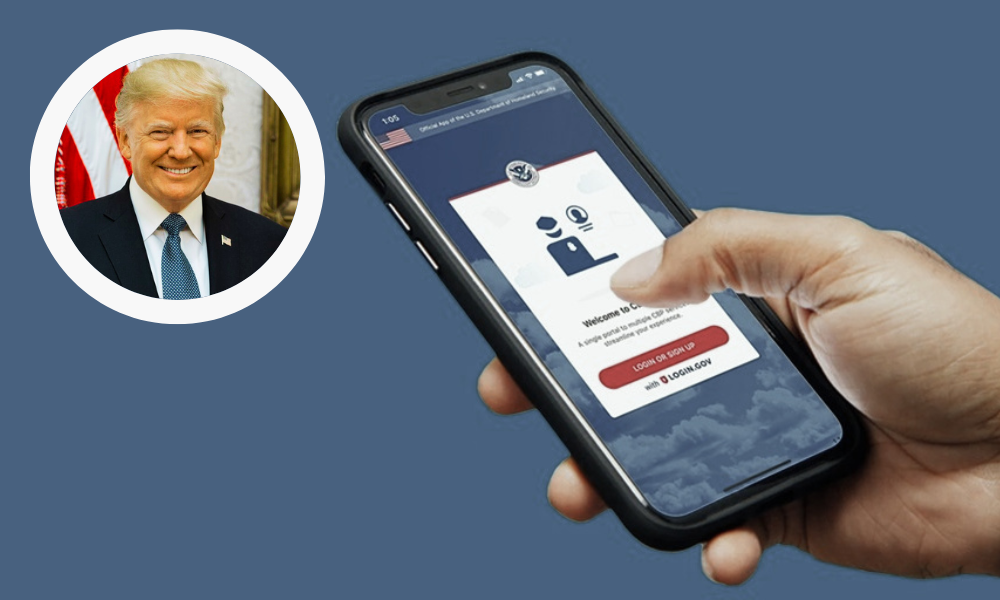
Chioma has lived in Texas for 18 years. She wakes up early to prepare breakfast for her three children, all U.S. born citizens. She works long hours cleaning office buildings, pays taxes, and has never been arrested. But now, with one tap on a new government app, she’s being asked to consider an impossible choice: of self deportation and leave the country she calls home—or risk detention.
The CBP Home app, launched under the Trump administration, is being pitched as a humane, tech-driven solution to streamline immigration processes. It allows undocumented immigrants to self-report their departure from the U.S., avoiding formal deportation proceedings. Supporters hail it as a step toward efficiency and dignity. Critics, however, see it as something far more insidious: a digital pressure tactic disguised as convenience.
ALSO READ: The Impact of U.S. Deportation Policies on African Migrants
Is this app a tool for compassionate immigration reform, or a high-tech mechanism for mass deportation? And what does it mean for the millions of undocumented immigrants living in the U.S.—many of whom have deep family and economic ties to the country?
The app raises urgent questions. Will it lead to increased surveillance of immigrant communities? Could families be torn apart? And ultimately, does it truly give immigrants control over their fate—or is it a trap?
What Is the CBP Home App?
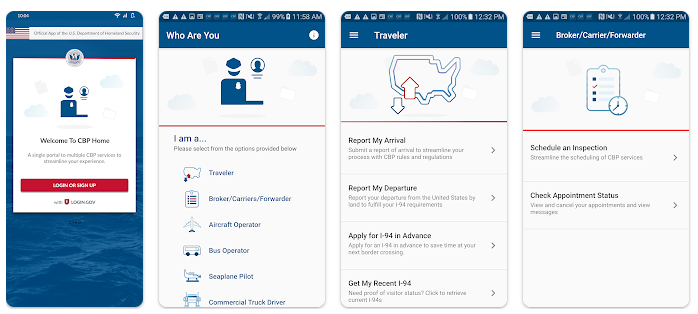
The CBP Home app is a mobile application developed by U.S. Customs and Border Protection (CBP) under the Department of Homeland Security (DHS). Launched in March 2025, it serves as a digital platform providing various immigration-related services.
Evolution from CBP One to CBP Home
Originally introduced in October 2020, the CBP One app was designed to assist commercial trucking companies in scheduling cargo inspections. In 2023, its functionality expanded to allow migrants to schedule asylum appointments at U.S. ports of entry, aiming to streamline the asylum application process.
However, upon President Donald Trump’s re-assumption of office in January 2025, the administration terminated the use of CBP One, citing concerns over its facilitation of illegal immigration. The app was subsequently rebranded and relaunched as CBP Home, shifting its focus from facilitating legal entry to managing voluntary departures.
Key Features of CBP Home
The CBP Home app offers several functionalities some of which include:
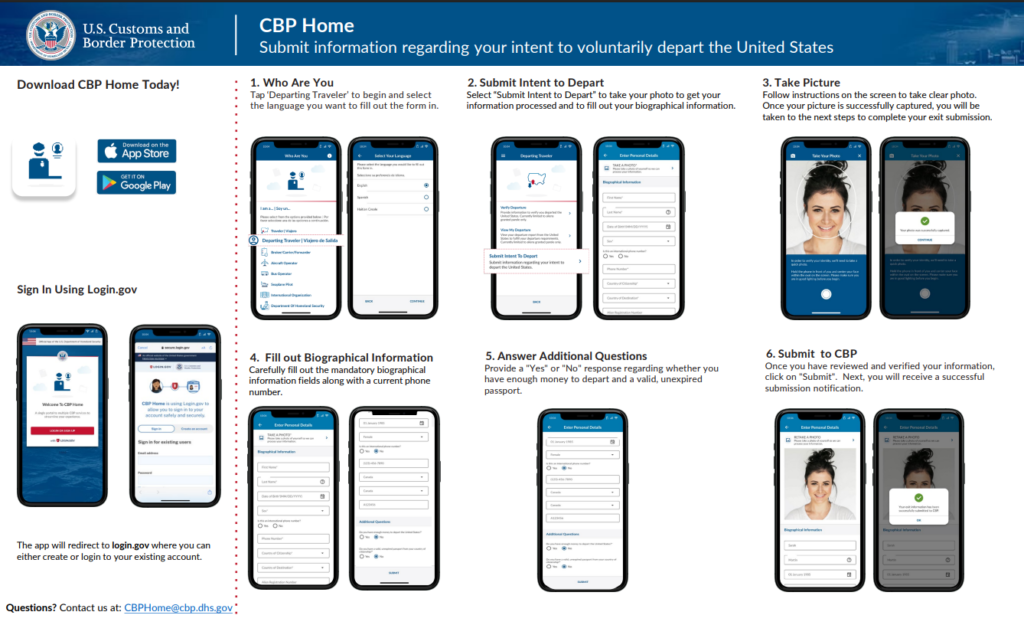
- Self deportation registration – The most controversial feature, enabling undocumented immigrants to report their own departure from the U.S.
- Check Border Wait Times: Provides real-time updates on wait times at land ports of entry.
- Apply for a Provisional I-94 Entry: Enables travelers to apply for a provisional I-94 permit before arriving at a land border crossing, expediting the entry process
- Request an Inspection of Agriculture or Biological Products: Allows travelers arriving at airports to request inspections of biological materials, food items, live animals, or hunting trophies.
Removed Features from CBP One
With the transition to CBP Home, certain features available in CBP One have been discontinued:
- Asylum Appointment Scheduling: Previously, CBP One allowed migrants to schedule asylum appointments at U.S. ports of entry. This functionality has been removed in CBP Home, aligning with the current administration’s focus on enforcing stricter immigration controls.
- Humanitarian Parole Applications: The feature that facilitated applications for humanitarian parole has been eliminated, reflecting a shift in immigration policy under the new administration.
ALSO READ: USAID’s Suspension Threatens Africa’s Most Vulnerable Communities
Impact Of The App Shift

The abrupt transition from the CBP One app to CBP Home had significant repercussions for migrants who were actively engaged in the legal immigration process:
- Cancellation of Scheduled Appointments: Effective January 20, 2025, all appointments previously scheduled through the CBP One app were canceled. Migrants who had secured dates for asylum interviews or other immigration processes were notified of these cancellations, leaving many in a state of uncertainty.
- Disruption of ‘Due Process’: Individuals adhering to legal protocols via the CBP One app found their pathways disrupted. The removal of the scheduling functionality eliminated a structured avenue for seeking asylum, compelling many to seek alternative, often perilous, methods to pursue their claims.
- Stranded Migrants: The sudden policy shift left thousands of migrants stranded in border regions, particularly in Mexican border towns. These individuals, who had been waiting for their appointments, now faced prolonged uncertainty and potential exposure to dangerous conditions.
With millions of undocumented immigrants in the U.S., the stakes are high.
The Case for the CBP Home App
Supporters of the CBP Home app argue that it introduces several benefits to the immigration system. Government officials, policy analysts, and conservative lawmakers emphasize that the app provides many benefits.
✅ Efficiency & Digital Streamlining
Immigration proceedings can be notoriously slow and bureaucratic. Proponents argue that by digitizing parts of the process, the CBP Home app reduces paperwork, speeds up processing, and minimizes government resource use.
“This is about modernization,” said Alex Castillo, a former DHS official. “We already have mobile check-ins for flights, digital customs forms, and online visa applications. Why not offer a digital solution for voluntary departures?”
For an administration focused on cutting costs and reducing administrative burden, the app represents a step toward a tech-driven approach to border enforcement.
✅ Potential for Legal Re-Entry
Another key argument in favor of the app is that those who voluntarily leave may have an easier time applying for legal re-entry in the future.
Immigration attorney Daniel Schwartz explained:
“A formal deportation order can carry a reentry ban of 5, 10, or even 20 years. Voluntary departure, on the other hand, could allow individuals to return legally under the right circumstances.”
The Trump administration has suggested that self-reporting departures may increase the likelihood of being considered for legal immigration pathways in the future, though details remain vague.

✅ Better Immigration Data & Policy Adjustments
Government officials also argue that tracking voluntary departures could provide valuable data that helps refine immigration policies.
By analyzing self-reported departures, CBP could better understand:
- Which regions see the most voluntary departures
- Common reasons why individuals choose to leave
- The effectiveness of immigration enforcement strategies
✅ A Less Traumatizing Exit
Under traditional immigration enforcement, undocumented individuals often face:
- Raids by Immigration and Customs Enforcement (ICE)
- Detention in overcrowded and under-resourced facilities
- Prolonged deportation proceedings
Supporters claim that the CBP Home app eliminates these traumatic experiences by allowing individuals to leave on their own terms, free from the fear of an ICE raid or unexpected detention.
DHS Secretary Kristi Noem described it as a “humane alternative” to traditional deportation methods.
“We’re giving people the power to choose a voluntary, orderly exit rather than facing raids, arrests, or prolonged detention,” she said in a press briefing.
The Concerns and Controversies
Many immigration advocates aren’t buying that explanation. To them, the phrase “voluntary self-deportation“ is misleading.
???? Is It Truly Voluntary?
One of the biggest concerns is whether immigrants are actually choosing to use the app—or if they feel forced into it.
“Voluntary departure” sounds like an option, but for many undocumented immigrants, it may be a choice between self deportation or indefinite detention in inhumane conditions.
“You’re making yourself a target. You’re saying, ‘I’m here without status, and I don’t have a legal reason to be here,'” said Michael Wirz, an immigration attorney based in El Paso
???? Surveillance Risks for Mixed-Status Families
Another major concern is whether the app puts mixed-status families under government scrutiny. Many undocumented immigrants live with U.S. citizens or legal residents—whether as spouses, children, or extended family members. Critics worry that using the CBP Home app could lead to increased surveillance on these households, putting legal residents at risk of investigation.
Privacy experts also warn that the app may collect location data, biometric details, and personal history, potentially feeding into broader immigration enforcement databases.
???? The Dreamer Dilemma
Many undocumented immigrants, especially DACA recipients and those who arrived as children, have no real ties to their birth countries.
For them, self deportation isn’t just leaving a country—it’s leaving their entire identity, community, and life behind.
“I was 18 months old when my parents brought me to the U.S.,” said Kwame., a DACA recipient. “If I ‘voluntarily’ leave, I have no home, no job prospects, and no connections in Ghana. What am I supposed to do?”
???? Who Pays for Deportation?
One key detail missing from the CBP Home app’s rollout: Who covers the costs of leaving? If an immigrant chooses self deportation but lacks the financial resources for a plane ticket or travel arrangements, does the U.S. government provide assistance?
So far, DHS has not provided clear answers, leading to speculation that many immigrants might end up stranded in a legal and logistical limbo—unable to stay, yet unable to afford leaving.
???? What About Families with U.S.-Born Children?
Over 4.4 million U.S.-born children have at least one undocumented parent. If an undocumented parent self-deports, what happens to their American-born children?
- Does the CBP Home app provide resources for parents navigating family separation?
- Can U.S. citizen children accompany their parents without losing rights?
- Will these families receive legal guidance on maintaining parental custody across borders?
So far, DHS has not addressed these concerns. Immigration lawyers fear this could lead to situations where:
- Parents feel pressured to leave their children behind to avoid forcing them into uncertain conditions.
- Families are torn apart without a clear reunification process.
- U.S.-born children face de facto deportation as they are forced to relocate with their undocumented parents.
Expert Opinions and Public Reactions
Immigration rights groups have been vocal in their criticism, arguing that the app creates a false sense of choice while pressuring undocumented individuals to leave.
“This is an insidious tool of coercion, dressed up as an administrative convenience,” said Jacqueline Bhabha, a professor at Harvard’s FXB Center for Health and Human Rights. “When you have no good alternatives, self deportation isn’t voluntary—it’s forced compliance.”
However, not everyone sees the app as a tool for coercion. Some policy analysts and former government officials argue that the CBP Home app simply digitizes a process that has long existed and offers an alternative to ICE raids and prolonged detention.
Robert Gaines, a policy strategist at the Center for Immigration Reform, defended the initiative, saying:
“We have digital customs forms, online passport renewals, and even electronic visa processing. It only makes sense to modernize voluntary departure as well. The app isn’t forcing people to leave—it’s giving them a structured way to do so.”
Perhaps the most devastating impact of the app’s rollout is on migrants who were already following legal processes under CBP One before its abrupt rebranding. When the new administration canceled thousands of asylum appointments, thousands of migrants were left stranded in border cities like Tijuana, Ciudad Juárez, and Matamoros.
Conclusion
The CBP Home app presents itself as a convenient tool, but its implications stretch far beyond a simple digital service.
Is CBP Home a step toward a fairer immigration process, or is it the first digital tool in an evolving system of mass digital surveillance?
For many immigrants, this is not just a policy shift—it is a life-altering decision. And in a world where technology is increasingly being used to enforce immigration laws, the CBP Home app might just be the first step in a new, digital frontier of border control—one that raises more questions than it answers.