


There are leaders who speak to a nation, and there are leaders who speak to a people scattered across continents.
The Reverend Jesse Louis Jackson belonged to the latter.
For more than half a century, Jesse Jackson stood at the intersection of pulpit and protest, ballot and boycott, diplomacy and defiance. From the segregated streets of Greenville, South Carolina, where he was born in 1941, to the charged political conventions of the 1980s and the liberation rallies that echoed from Chicago to Johannesburg, Jesse Jackson fashioned himself into a moral courier — carrying the language of dignity across oceans.
His politics were unmistakably American. His resonance was unmistakably diasporic.
To understand Jesse Jackson fully is to see him not only as a civil rights leader in the shadow of Martin Luther King Jr., but as a bridge figure — one who insisted that the struggle in Birmingham was connected to the struggle in Soweto, that apartheid abroad and segregation at home were variations of the same moral failure.
ALSO READ: Why Black History Month Is In February And The Need For African Solidarity
From King’s Movement to His Own
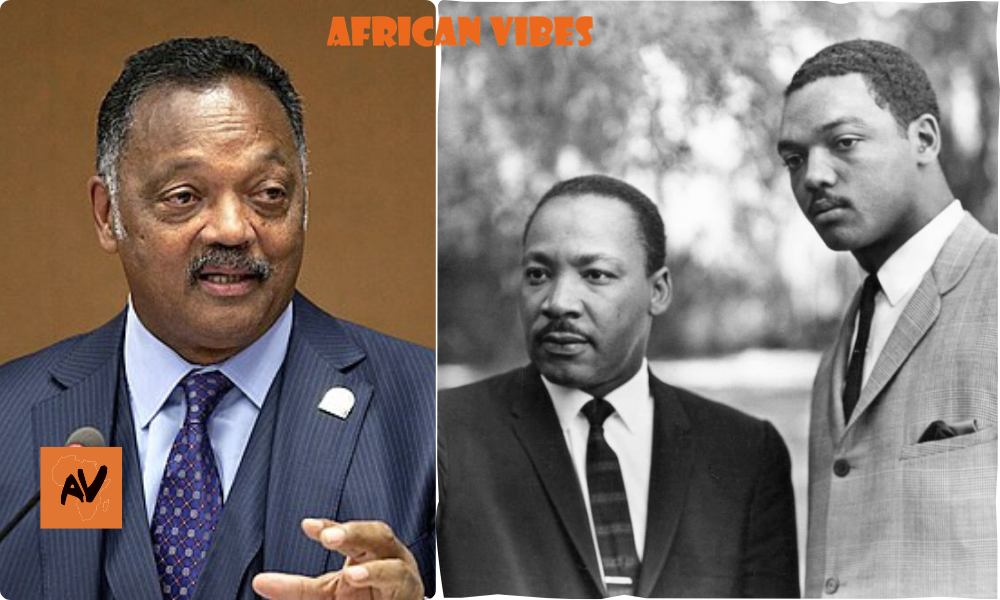
Jackson rose to prominence as a young organizer under Dr. King, leading Operation Breadbasket in Chicago, where he pressured corporations to hire Black workers and invest in Black communities. After King’s assassination in 1968, Jesse Jackson emerged as one of the most visible inheritors of the movement’s energy — though not without controversy and internal disputes.
In 1971, he founded Operation PUSH (People United to Save Humanity), expanding the civil rights framework to include economic justice, corporate accountability, and political empowerment.
Jesse Jackson understood early that civil rights without economic leverage would remain incomplete. That conviction shaped his presidential campaigns in 1984 and 1988, when he became the second African American (after Shirley Chisholm) to mount a serious bid for the White House — and the first to win multiple state primaries and millions of votes.
But even as he sought America’s highest office,Jesse Jackson’s gaze was never confined to American borders.

Apartheid: A Moral Line in the Sand
During the 1980s, as South Africa’s apartheid regime intensified repression, the United States faced a defining question: Should it impose sanctions on Pretoria or maintain engagement in the name of Cold War strategy?
The Reagan administration chose “constructive engagement.” Jesse Jackson chose confrontation.
He became one of the most visible American political figures advocating for comprehensive economic sanctions against South Africa. At rallies, on college campuses, and during his presidential campaigns, he argued that apartheid was not merely a foreign policy issue but a moral emergency.
He insisted that American corporations operating in South Africa were entangled in racial oppression. He supported the growing divestment movement that pressured universities, churches, and pension funds to withdraw investments.
In 1985, Jackson traveled to South Africa, where he met with anti-apartheid leaders and publicly condemned white minority rule. At a time when Nelson Mandela remained imprisoned and some Western leaders still hesitated to embrace him fully, Jesse Jackson treated Mandela as a legitimate political leader.
He drew explicit parallels between Jim Crow laws and apartheid’s pass system. Between voter suppression in the American South and disenfranchisement in South Africa.
The message was clear: injustice was not geographically contained.
When Congress passed the Comprehensive Anti-Apartheid Act in 1986 — overriding President Reagan’s veto — it marked a turning point in U.S. policy. Jackson was not alone in that fight, but he was among the most nationally visible voices helping to mobilize public pressure.
For many in the African diaspora, his advocacy signaled that the continent’s liberation struggles had allies inside American power structures.
ALSO READ: 50 Inspiring Black History Month Quotes
The Rainbow Coalition: Diaspora by Design
In 1984, Jackson formalized his political philosophy under the banner of the Rainbow Coalition.
Often described in shorthand as a multiracial alliance of marginalized Americans, the coalition was more expansive than that. It was rooted in the belief that economic and racial injustice were interconnected across communities — and across borders.
The Rainbow Coalition included African Americans, Latino communities, Asian Americans, Native Americans, labor unions, poor farmers, progressive faith groups — and importantly, African and Caribbean immigrants.
By the 1980s, growing African immigrant communities were reshaping American cities. Nigerians in Houston and Chicago. Ethiopians in Washington. Ghanaians in New York. Jackson recognized that Black political identity in America was evolving — and he argued that it should be anchored in shared heritage rather than divided by national origin.
He helped popularize the term “African American,” advocating for language that connected descendants of enslaved people to the continent from which their ancestors were taken.
It was more than semantics. It was political geography.
He once described America not as a single cloth but as a quilt — “many patches, many pieces, many colors, many sizes, all woven together by a common thread.” That metaphor extended beyond domestic diversity. It suggested that diaspora communities were threads in a larger tapestry of shared destiny.
Words as Mobilization
Jesse Jackson’s gift was cadence.
He was at once preacher and political tactician, capable of compressing complex struggle into phrases that traveled.
Among his most enduring declarations:
“I am — Somebody.”
“Keep hope alive.”
“If my mind can conceive it, and my heart can believe it, then I can achieve it.”
“Our flag is red, white and blue, but our nation is a rainbow — red, yellow, brown, black and white — and we are all precious in God’s sight.”
“We may be in the slum, but the slum is not in us.”
These were not merely affirmations; they were organizing tools. In townships and tenements alike, dignity had to be asserted before it could be institutionalized.
Beyond Rhetoric: Diplomatic Interventions
Jesse Jackson’s global engagement extended beyond South Africa.
In 1999, he traveled to Sudan and negotiated the release of American and European humanitarian workers detained during the country’s civil war. Though he held no formal government office, he leveraged moral authority and international relationships to secure their freedom.
He undertook similar diplomatic efforts in Syria, Cuba, and Kosovo over the years — positioning himself as an unofficial envoy capable of opening doors where formal channels stalled.
These missions were sometimes controversial. Critics questioned the optics and outcomes. But they underscored Jackson’s belief that moral persuasion could function as soft power.
Complexity and Criticism
No serious accounting of Jackson’s life omits controversy.
He faced criticism over political tactics, personal missteps, and statements that drew backlash, including a widely condemned remark during his 1984 campaign for which he later apologized. His career contained contradictions and evolving positions.
Yet even critics acknowledged his singular ability to expand the boundaries of possibility for Black political leadership.
His 1988 presidential campaign, in particular, demonstrated that a Black candidate could assemble a broad, multiracial electoral coalition. Decades later, when Barack Obama secured the presidency, the path was not unprecedented.
Jesse Jackson had walked part of it first.
Africa, America, and the Unfinished Struggle
Jesse Jackson did not design U.S.–Africa trade policy. He did not broker continental development agreements. He was not an architect of economic frameworks like AGOA.
His influence was of a different order.
He helped make apartheid impossible to ignore in American politics.
He insisted that African liberation movements deserved legitimacy.
He reframed Black identity in America to explicitly acknowledge African lineage.
He welcomed African immigrants into a political vision rather than treating them as peripheral to it.
At a time when Africa was often marginalized in Western political discourse, Jesse Jackson placed it at the center of moral debate.
He understood that the Atlantic Ocean was not a divider — it was a corridor of history.
The Long Echo
Reverend Jesse Jackson’s legacy resists simplification.
He was a civil rights organizer shaped by King.
A presidential candidate who expanded democratic imagination.
An anti-apartheid advocate who treated African freedom as inseparable from American justice.
A coalition builder who anticipated a more global Black identity.
Above all, he was a voice — rhythmic, relentless, hopeful.
“Keep hope alive,” he urged crowds for decades.
For some, it was a slogan.
For others, especially across the African diaspora, it was instruction.
The arc of justice, he believed, required pressure. It required faith. It required coalition.
And it required remembering that struggles separated by geography are often united by history.
In that sense, his life was not only American.
It was diasporic.