



When Violet Amoabeng launched Skin Gourmet in 2014, the global beauty industry was already worth hundreds of billions of dollars—but it was also facing rising consumer distrust over synthetic ingredients, preservatives, and opaque supply chains.
Violet Amoabeng’s response was unconventional. Rather than reformulate existing cosmetic standards, she rejected them entirely.
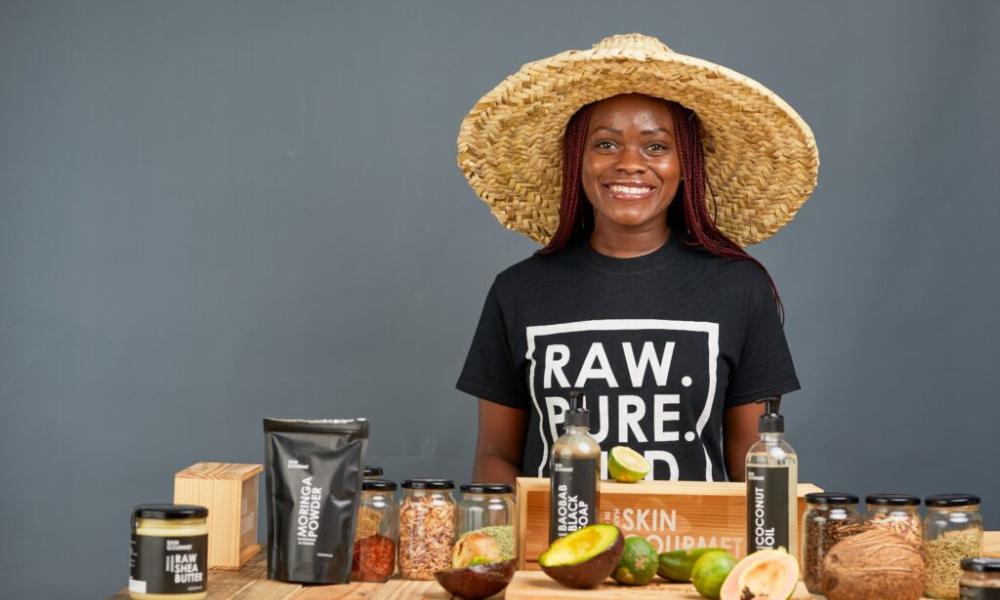
Her guiding belief—“Nature is perfect; it’s man that is flawed”—became the foundation of a brand built on edible-grade skincare, made exclusively from raw, wild-sourced ingredients harvested in Ghana. Every product, she insists, is safe enough to eat—an extreme benchmark that immediately set Skin Gourmet apart in the emerging clean beauty market.
Today, the brand operates in markets across five continents, has achieved consistent growth without external investment, and is increasingly cited as a case study in sustainable African entrepreneurship.
From Personal Philosophy to Scalable Business
Skin Gourmet’s origin lies in Violet Amoabeng’s conviction that skin health is inseparable from overall body health. Concerned by the long-term effects of chemical-heavy cosmetics, she turned to indigenous Ghanaian ingredients—particularly unrefined shea butter sourced from the bush—as the basis for truly natural skincare.
Unlike many founders in the wellness space, Violet Amoabeng paired this philosophy with formal business training. With an MBA and roots in a family of entrepreneurs, she approached Skin Gourmet not as a lifestyle brand but as a scalable commercial enterprise capable of competing internationally.
What emerged was a tightly controlled production model that values ingredient integrity over mass manufacturing efficiency—an approach that has become central to the brand’s identity.
Sustainability as Operations, Not Marketing
Sustainability at Skin Gourmet is not positioned as a branding layer; it functions as an operational principle.
The company produces its skincare using traditional handmade methods, avoids preservatives entirely, and operates on a zero-waste philosophy, including minimal and reusable packaging. These choices, while limiting rapid industrial scaling, preserve the nutritional and therapeutic properties of each ingredient.
Perhaps most notably, Skin Gourmet sources directly from rural Ghanaian communities, bypassing intermediaries and implementing fair trade practices. According to the company, this model has increased producer incomes by as much as 300%, particularly benefiting women involved in shea harvesting and processing.
The result is a supply chain designed to generate economic value locally—rather than extract it.
ALSO READ: Best Skincare Routines That Will Restore The Glow Of Your African Skin
Competing With Global Beauty Giants
Despite rejecting synthetic shortcuts and venture capital funding, Skin Gourmet reports annual revenue growth of approximately 80%, placing it among the fastest-growing African-owned clean beauty brands.
Its products now compete in international markets traditionally dominated by multinational cosmetic corporations. However, Skin Gourmet’s differentiation lies in its refusal to dilute standards to meet scale.
The brand has also become a source of employment in underserved communities, with a hiring philosophy that prioritizes skills development over formal education credentials. Internally, this approach is summarized by the company’s guiding principle: “Developing People, One Jar at a Time.”
In a sector often criticized for performative social responsibility, Skin Gourmet has embedded community uplift directly into its business model.

ALSO READ: 8 Tips To Grow Your Natural Hair Faster
A Long-Term Vision Rooted in African Ownership
Looking ahead, Violet Amoabeng’s ambitions extend beyond product expansion. Her focus includes intellectual property protection, long-term African ownership of production processes, and positioning Skin Gourmet as a global reference point for people-centered sustainable beauty.
Underlying this vision is a broader critique of aid-driven development narratives. Skin Gourmet’s success, Violet Amoabeng argues, demonstrates that African economies can build global relevance through innovation, ethical enterprise, and control over natural resources.
Rather than exporting raw materials, the company exports finished value—designed, manufactured, and branded on the continent.
Redefining What African Beauty Can Represent
Skin Gourmet’s rise reflects a larger shift in global consumer behavior toward transparency, wellness, and sustainability. But it also highlights a deeper redefinition of African entrepreneurship—one that centers ownership, cultural knowledge, and long-term community impact.
For Violet Amoabeng, the goal is not merely to sell skincare, but to reshape how beauty products are made, who profits from them, and what values they reflect.
In an industry driven by speed and scale, Skin Gourmet is betting that integrity, nature, and people can still win.