


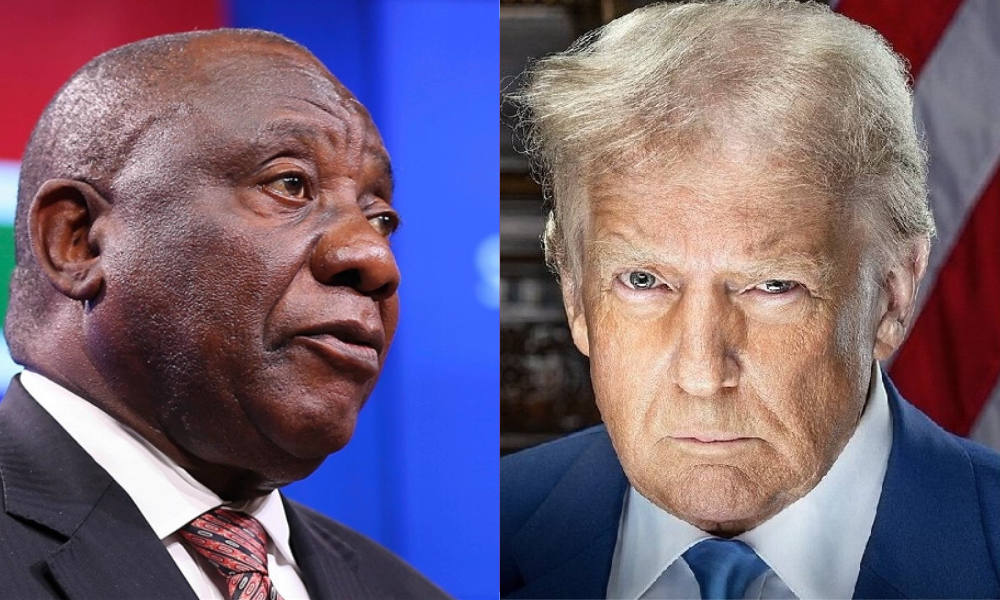
The political drama surrounding the upcoming G20 Leaders Summit in Johannesburg, South Africa, just got a headline twist. Former U.S. President Donald Trump has declared that he will not be attending the event, citing what he claims is the “victimisation of white people” in South Africa. His controversial remarks have reignited tensions between the two nations, casting a diplomatic shadow over what is set to be a historic summit—the first G20 meeting on African soil.
Trump’s Stated Reasons: “Land Grabs” and “White Genocide”
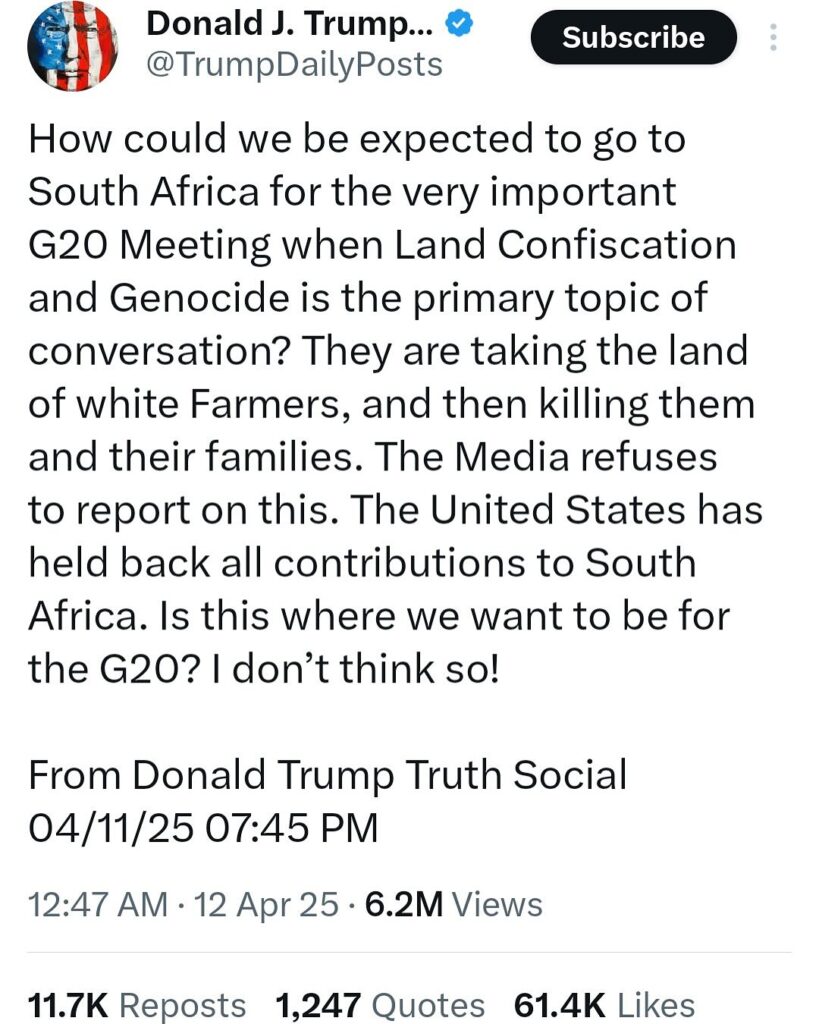
In multiple statements on his social media platform, Truth Social, Trump reiterated his belief that South Africa is engaged in systemic violence and land confiscation targeting white farmers.
“How could we be expected to go to South Africa for the very important G20 Meeting when Land Confiscation and Genocide is the primary topic of conversation? They are taking the land of white Farmers, and then killing them and their families…” — Donald Trump, Truth Social
These claims—widely debunked and criticized by international human rights organizations—are not new. Trump previously made similar statements during his presidency, sparking international backlash and a strained diplomatic relationship with South Africa.
ALSO READ: Nigeria Lands $1.1B Loan for Operation Light Up Nigeria
South Africa Responds: Business as Usual
South African officials have brushed off Trump’s decision with an air of indifference. Government spokespersons have confirmed that they were not expecting Trump to attend and that his absence will not hinder summit proceedings.
In a statement, a presidential aide noted:
“The G20 is a multilateral forum. The absence of one individual, no matter how prominent, does not change the agenda or the commitments we aim to uphold.”
Despite Trump’s boycott, the United States will still send a delegation to represent its interests at the summit, ensuring continued participation in discussions on global economic development, trade, and climate goals.
Rising Tensions and a Pattern of Disengagement
Trump’s decision to skip the G20 follows a broader pattern of disengagement with South Africa under his leadership. Earlier in 2025, U.S. Secretary of State Marco Rubio also pulled out of a G20 foreign ministers’ meeting in Johannesburg, citing similar concerns over land reform policies.
Additionally, Trump has frozen U.S. aid to South Africa, a move seen by many analysts as further evidence of fraying diplomatic ties.
What’s on the Agenda: G20’s Evolving Priorities
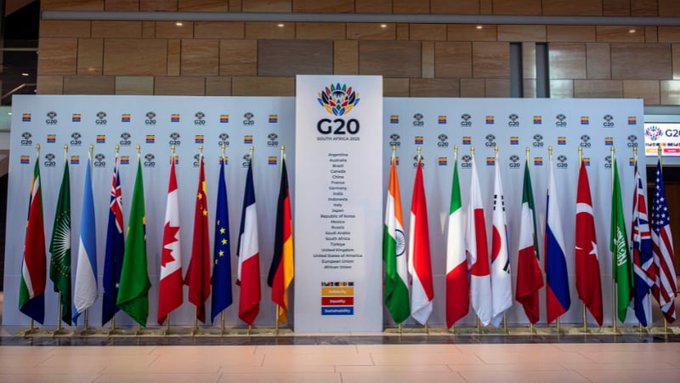
While Trump’s absence makes headlines, the real story is the evolving role of the G20 itself. From its origins as a forum for financial stability, the G20 now tackles a broad array of global issues. Under Brazil’s presidency in 2024 and South Africa’s leadership in 2025, the G20 has committed to inclusive and transformative priorities:
???? Ending Hunger and Poverty
The Global Alliance Against Hunger and Poverty, spearheaded by Brazil and backed by South Africa, aims to accelerate progress toward the UN’s 2030 goals. Leaders are exploring ways to reduce global inequality and promote inclusive growth—especially important given recent inflationary pressures and widening global income gaps.
???? Reforming Global Institutions
There’s renewed energy around modernizing institutions like the UN, IMF, and World Bank to reflect a multipolar world. South Africa and other emerging economies have long advocated for more equitable representation in global governance.
???? Clean Energy and Climate Action
With the climate crisis escalating, G20 countries are discussing how to achieve greener, just energy transitions. South Africa is uniquely positioned to lead this conversation, given its efforts to decarbonize while addressing local development needs.
???? Geopolitical Tensions and Trade
From the war in Ukraine to U.S.-China trade tensions, leaders are using the G20 as a space to manage global instability. While these discussions are sensitive, multilateral cooperation is seen as the best path forward.
???? Sustainable Development and the Digital Economy
The 2025 Summit will also feature dialogue on digital innovation, job creation, and civil society participation—ensuring that voices outside traditional power structures are heard.
Why the Summit Still Matters
Despite the controversy, the G20 Summit scheduled for 22–23 November 2025 remains a pivotal event. As the first G20 gathering hosted on African soil, the Johannesburg summit holds symbolic and strategic importance. With South Africa holding the G20 presidency, the country plans to spotlight African development priorities, including sustainable infrastructure, equitable trade, and climate resilience.
Ironically, the United States is set to assume the next G20 presidency in December 2025, making continued engagement with the forum vital, regardless of leadership-level absences.
Conclusion: Summit Will Go On
Donald Trump’s decision to boycott the 2025 G20 Summit in South Africa over unverified claims has added a dramatic layer to the geopolitical landscape. Yet, South African officials remain unbothered, reaffirming that the summit will move forward with or without the former U.S. president. While diplomatic tensions continue to simmer, the G20 remains an essential forum for global cooperation—and one that the United States is unlikely to abandon.
Check our Socials For Amazing Discussions