


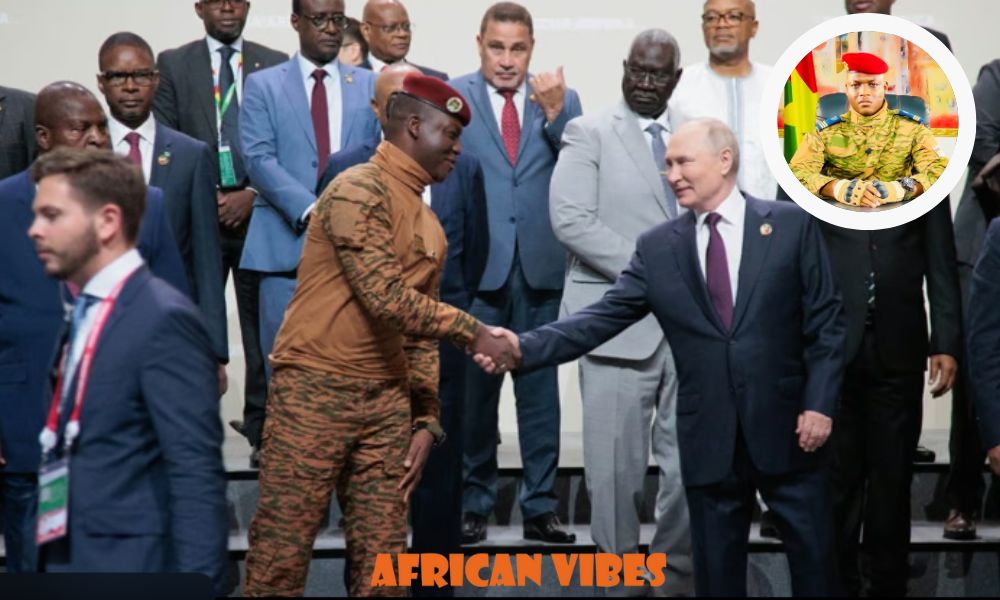
When Russian Foreign Minister Sergey Lavrov announced that 90% of diplomats expelled from Europe would be redeployed to Africa, he was not merely describing a staffing adjustment. He was confirming a strategic shift.
Since the Ukraine war erupted in 2022, Russia has faced a sweeping diplomatic rollback across the West. More than 500 Russian diplomats were expelled from European countries, part of a coordinated effort to isolate Moscow politically and punish it economically. Yet instead of shrinking its global presence, Russia has chosen to relocate it.
The continent absorbing that redeployment is Africa — a region Russia increasingly views not as a peripheral theatre, but as the most contested arena of the emerging multipolar world.
ALSO READ: Ethiopia and Russia Seal Historic Nuclear Energy Agreement
From sanctions to strategy
Russia’s pivot to Africa has been building for years. The first Russia-Africa Summit in Sochi in 2019 marked Moscow’s effort to re-enter a continent where Soviet influence once ran deep. That momentum continued through the early 2020s, and despite the war in Ukraine, Moscow has not abandoned its African diplomacy — it has accelerated it.
Now, Lavrov’s statement provides a clear rationale: as Europe closes its doors, Africa is opening its capitals.
Russia’s foreign ministry has confirmed plans to expand its diplomatic footprint to 49 African embassies, reversing decades of post-Soviet closures. The expansion is not concentrated in one or two “anchor” countries. Instead, it is spread across strategic corridors — the Sahel, West Africa, and the Indian Ocean — regions where Russia believes influence can be gained quickly and institutionalized ahead of the next Russia-Africa Summit planned for 2026.
A diplomatic blitz across Africa
Russia has already begun reopening missions that were shuttered in the 1990s and early 2000s. Among the most symbolic were the reopenings of embassies in Burkina Faso and Equatorial Guinea between 2023 and 2024 — early signs that Moscow’s pivot was not rhetorical.
But the most ambitious phase is still ahead.
Russia has announced plans to open new embassies or restore old ones in at least seven African countries by 2026:
- Comoros (embassy in Moroni expected by 2025)
- Gambia
- Liberia
- Niger
- Sierra Leone
- South Sudan
- Togo
This list matters for more than diplomatic symbolism. Each country sits within a wider strategic map. Comoros offers an Indian Ocean foothold. Niger sits at the heart of the Sahel security crisis. South Sudan is a fragile oil state. Liberia and Sierra Leone are resource-rich West African countries. Togo offers access to coastal West Africa and regional trade routes.
In short, Russia is planting flags in locations that expand its leverage across Africa’s most geopolitically sensitive zones.
ALSO READ: Ibrahim Traoré’s Security Pact With Putin
Security first: the Sahel as Russia’s fastest win
If Russia’s diplomatic expansion is the visible headline, its security strategy is the engine behind it.
Russia’s most rapid gains in Africa have come not through trade or investment, but through military cooperation, particularly in the Sahel — a region shaken by coups, insurgencies, and Western withdrawal.
Over the past few years, France has reduced its military footprint across the Sahel, following expulsions and political breakdowns with governments in Mali, Burkina Faso, and Niger. The United States has also scaled back certain security engagements, especially after the 2023 coup in Niger.
Into that vacuum stepped Russia.
Through the Africa Corps, widely described as the state-controlled successor to Wagner, Moscow has built security partnerships with the Sahel’s new military-led governments. The deals vary by country but share common elements: military training, equipment supply, counterterrorism support, and regime protection.
In Mali, a major security agreement was reportedly strengthened in 2025 during transitional leader Assimi Goïta’s Moscow visit. The partnership includes training, equipment supply, and the integration of Russian personnel into joint operations. Mali has also received military hardware such as armoured vehicles and artillery systems, according to multiple regional reports.
In Niger, Russian personnel have reportedly supported security operations following the coup, with discussions around border monitoring and satellite surveillance cooperation. Niger’s strategic importance has only grown since it was one of the West’s key counterterrorism partners in the region before 2023.
In Burkina Faso, ties have expanded through training and support agreements as the government battles insurgent violence. Russia’s role has been amplified by high-profile political engagement between Ouagadougou and Moscow.
The most significant development came in August 2025, when Mali, Niger, and Burkina Faso — now grouped under the Alliance of Sahel States (AES) — signed a defence cooperation memorandum in Moscow. The agreement envisions deeper coordination and support for a planned 5,000-strong joint Sahel force, positioning Russia as the bloc’s key external partner.
For Moscow, the Sahel is not only a security theatre. It is a gateway to political influence, mineral access, and long-term leverage.
Energy, minerals and the economics of influence
Despite the headlines, Russia’s economic footprint in Africa remains relatively small compared to its rivals. Total Russia-Africa trade is estimated around $24.5 billion, far below China’s vast economic reach.
Yet Moscow is targeting sectors where it can punch above its weight — especially those linked to sanctions resilience and strategic commodities.
The first is energy.
Russia has pursued energy cooperation across North and East Africa, including nuclear power discussions involving Rosatom and countries such as Ethiopia. In Central Africa, Russia has been linked to pipeline and oil infrastructure discussions, while major Russian energy companies have historically shown interest in exploration opportunities in states such as Algeria and Nigeria.
The second is mining.
Across parts of the Sahel and Central Africa, Russia’s security engagement is often intertwined with mineral access — particularly gold and, in some contexts, uranium and diamonds. The model is transactional: security support in exchange for concessions, contracts, or resource-linked economic influence.
The third is agriculture.
Russia has positioned itself as a major wheat exporter to Africa, particularly after disruptions caused by the Ukraine war. Grain diplomacy — alongside fertiliser supply — has become a key part of Moscow’s messaging, presenting Russia as a partner in food security rather than a driver of crisis.
Infrastructure and telecommunications remain secondary, though Russia has signalled interest in rail, ports, and satellite cooperation. But unlike China, Russia is not offering a continent-wide infrastructure blueprint. Its strategy is narrower and often tied to political and security relationships.
Russia’s target is not necessarily to outspend China. It is to become indispensable in specific states and sectors — especially those where Western influence is weakening.
A crowded field: Russia vs China vs the West
Russia’s Africa pivot is unfolding in an increasingly competitive environment.
China remains Africa’s dominant external economic actor. Through the Belt and Road Initiative, Beijing has funded ports, railways, roads, and power projects across the continent. China-Africa trade is estimated around $295 billion annually — dwarfing Russia’s.
The United States and Europe, meanwhile, have framed their renewed engagement around investment, governance, and private-sector partnerships. Washington has pushed an “investment-first” approach, attempting to counter China’s dominance without replicating its state-led lending model.
Russia’s approach is different.
China builds.
The West invests and conditions.
Russia secures.
That difference explains why Russia has gained influence fastest in unstable regions — places where infrastructure investment is risky, Western engagement is constrained, and security is the most urgent demand.
But Africa is not simply being competed over. Increasingly, African governments are leveraging this rivalry to negotiate better terms, diversify partnerships, and assert sovereignty.
Why African leaders are engaging Moscow
For governments in the Sahel and beyond, Russia’s appeal rests on several factors.
First is its rhetoric of sovereignty and non-interference. Russian officials frequently present Moscow as a partner that does not lecture African states on governance, elections, or human rights.
Second is speed. In fragile security contexts, Russia offers rapid deployments, training, and equipment, often without the long bureaucratic processes that accompany Western security support.
Third is diversification. Many African states — even those aligned with the West — are wary of dependence on a single external bloc. Russia offers an additional bargaining chip.
However, engagement does not always mean alignment. Several African countries continue balancing relationships with Russia, China, the EU, and the US simultaneously.
The shift is not necessarily toward Russia. It is toward choice.
Risks and the road to 2026
Russia’s Africa strategy carries risks for both sides.
Russia’s financial capacity is limited compared to China’s. Its trade footprint is small. Its security-first approach ties it to unstable regimes and long-running insurgencies. And sanctions continue to constrain Russia’s ability to finance large projects.
For African states, the risks include opaque contracts, resource-linked deals that may weaken accountability, and the danger of becoming caught in great-power competition.
Yet the momentum is real.
Diplomatic expansion, security partnerships, and institutional dialogues — including forums such as the 2025 Cairo meeting — are laying the groundwork for the next Russia-Africa Summit expected in 2026. That summit is likely to be framed as a milestone: proof that Russia remains a global actor despite Western efforts to isolate it.
Africa’s multipolar moment
Lavrov’s redeployment announcement is ultimately about more than Russia. It is about Africa’s rising global weight.
Africa holds 54 UN votes. It has the world’s fastest-growing population, strategic minerals essential to the energy transition, and geographic positioning across key maritime routes.
Russia’s pivot is a recognition that influence in Africa increasingly shapes influence everywhere else.
The multipolar era may be chaotic. It may be competitive. But it is also negotiable.
And as global powers scramble to secure footholds, the continent’s greatest opportunity may lie in the one thing it has historically been denied:
The power to dictate terms.