


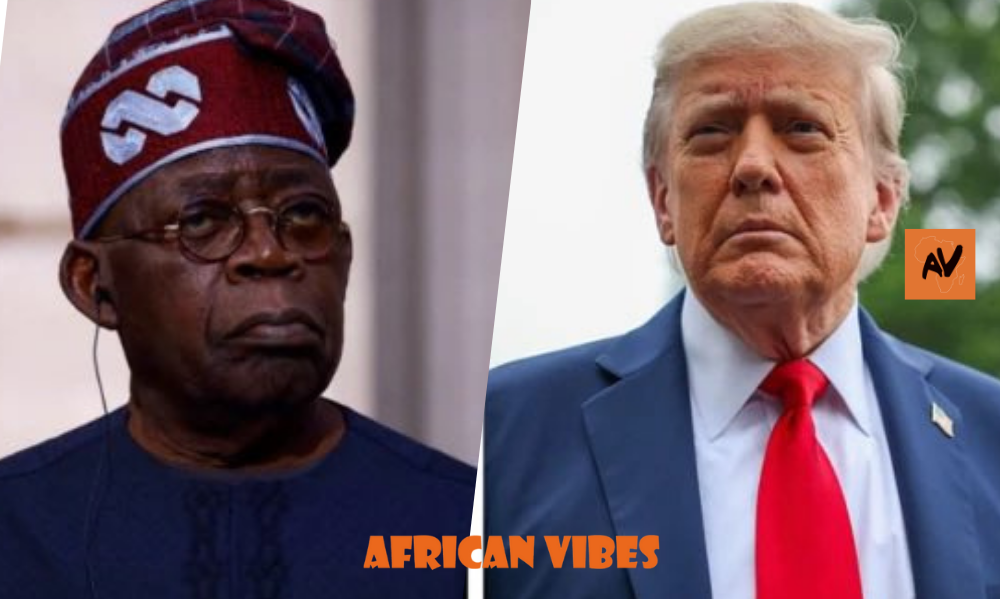
A diplomatic storm is brewing between Nigeria and the United States after former U.S. President Donald Trump threatened to cut aid and consider military intervention over alleged persecution of Christians. The remarks — paired with the reinstatement of Nigeria’s “Country of Particular Concern” (CPC) designation — have triggered outrage across Africa and reignited debates about Western interference in African affairs.
The Spark: Trump’s Allegations and CPC Reinstatement
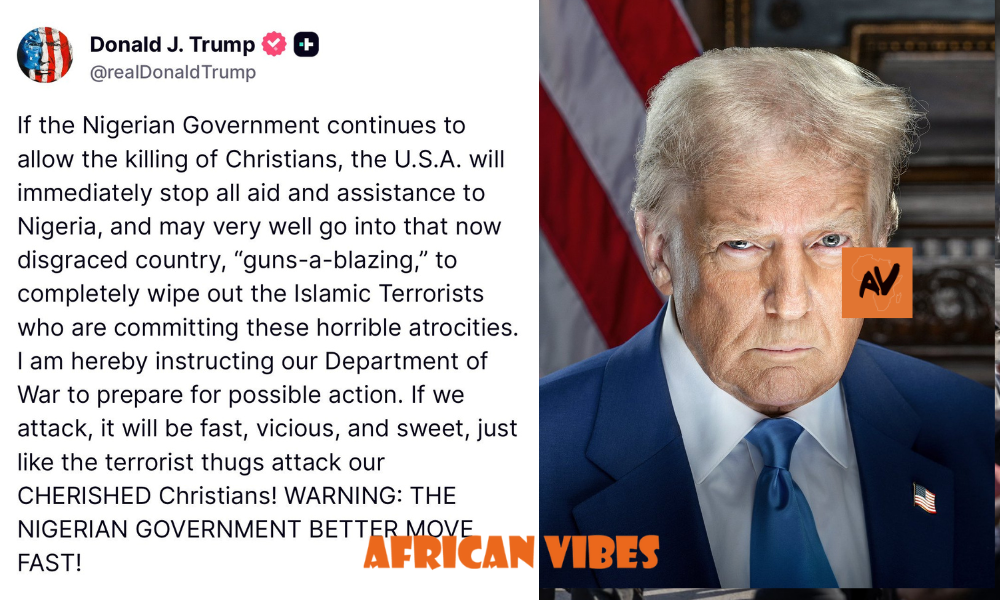
Trump’s remarks, made during a U.S. campaign rally, accused Nigeria of allowing the “mass slaughter of Christians,” threatening to send troops in “guns-a-blazing.”
The statement invoked the International Religious Freedom Act (IRFA) of 1998, which empowers the U.S. government to label nations as CPCs — a designation that can lead to sanctions.
Nigeria strongly rejects the claim, calling it a gross misrepresentation of its religious reality. Officials insist that violence in the country is not driven by faith but by a web of poverty, terrorism, and climate stress affecting both Muslims and Christians.
While conservative groups like Open Doors and Intersociety have cited alarming statistics about Christian deaths, Nigeria argues that such reports ignore the complex socio-economic and environmental dimensions of its conflicts.
Notably, Nigeria was first placed on the CPC list in 2020 under Trump, but President Biden removed it in 2021, signaling a reset in U.S.-Africa relations. Its reinstatement now suggests a return to ideological hardlines, where Africa once again risks being drawn into the crossfire of Western domestic politics.
ALSO READ: Mali’s Reciprocity Policy Forces U.S. to Scrap Visa Bond in Rare Diplomatic Reversal
Nigeria’s Firm Response: “Religious Tolerance Is Our Heartbeat”
In a rare show of unified resolve, the Nigerian Ministry of Foreign Affairs condemned the CPC label as “a gross misrepresentation of Nigeria’s national reality.”
President Bola Ahmed Tinubu reaffirmed the nation’s constitutional commitment to religious freedom and coexistence, stating:
“Religious tolerance is the heartbeat of our national identity — it has survived colonialism, civil war, and extremism, and it will survive this.”
Officials emphasize that Nigeria’s security crisis is not sectarian but systemic.
Groups like Boko Haram and ISWAP, which Trump’s rhetoric targets, have in fact killed more Muslims than Christians in northern Nigeria. Meanwhile, Middle Belt conflicts — often portrayed as religious — are in reality battles over land, water, and survival amid worsening climate stress.
To reduce this complex crisis to “Christian persecution,” officials argue, is to erase decades of socio-economic tension and misrepresent the government’s counterterrorism efforts. Nigeria is, in essence, asserting its right to self-definition and rejecting external ultimatums that echo colonial paternalism.
The Overlooked Story: Interfaith Unity on the Ground
Behind the grim headlines lies a quieter, more powerful story — one of grassroots peacebuilding and interfaith solidarity.
Across the country, local leaders and faith-based organizations are redefining what coexistence looks like:
- In Kaduna, communities participate in joint service projects, cleaning cemeteries and celebrating each other’s religious holidays.
- In Osun State, a bishop and an imam lead regular community dialogues that have defused potentially explosive disputes, including one over the wearing of hijab in schools.
- In Mando, a Christian traditional ruler recently funded a borehole for a local Islamic school, a gesture now hailed as a symbol of national healing.
Initiatives led by groups like the Global Peace Foundation Nigeria and the Interfaith Dialogue Forum for Peace (IDFP) are proving that Nigeria’s people — more than its politicians — are the true custodians of religious harmony.
This is the Nigeria often ignored by foreign narratives: a nation that, despite pain and loss, continues to rebuild trust through human connection and shared hope.
ALSO READ: Mali’s Reciprocity Policy Forces U.S. to Scrap Visa Bond in Rare Diplomatic Reversal
The Stakes: Aid, Security, and Humanitarian Fallout
President Donald Trump’s threat of cutting U.S. aid is not merely symbolic. It would have dire humanitarian and security consequences across West Africa.
- Counterterrorism at Risk:
U.S. support underpins Nigeria’s intelligence-sharing, training, and logistics — vital for ongoing operations against Boko Haram and ISWAP. Stripping this aid would weaken the region’s most important bulwark against terrorism. - Humanitarian Fallout:
Millions of internally displaced persons (IDPs) in Nigeria rely on U.S.-funded programs through the World Food Programme and other partners. Reducing aid would leave vulnerable populations exposed — fertile ground for extremist recruitment. - Public Health Setbacks:
Programs like PEPFAR, which have saved countless Nigerian lives, could be jeopardized. Such cuts would hit ordinary citizens hardest, not the government being punished.
For Abuja, this is not a plea for charity but a call for partnership. A partnership rooted in respect, realism, and shared interest in stability — not threats or conditional alliances.
Africa’s Message: Respect Our Sovereignty
This confrontation marks a pivotal moment for African sovereignty in global diplomacy.
Nigeria’s message is unambiguous: solutions to Africa’s problems must be led by Africans. External pressure, however well-intentioned, cannot substitute for local understanding and agency.
By rejecting Trump’s “guns-a-blazing” rhetoric, Nigeria defends more than national pride — it defends the principle of African self-determination.
As history shows, those who misread Africa’s complexity often underestimate its strength.
Nigeria’s story — of struggle, resilience, and unity amid adversity — continues to remind the world that Africa does not need saving; it needs to be heard.
Conclusion: Africa Writing Its Own Narrative
The dispute underscores how differently President Donald Trump and President Tinubu interpret the same crisis. To some in the United States, Nigeria represents a battleground for faith. To Nigerians themselves, it is a nation struggling — imperfectly but determinedly — to balance diversity, security, and unity.
The truth, as ever, lies somewhere between perception and reality.
For now, Nigeria’s message remains clear: while the country welcomes cooperation in tackling extremism, it will not accept external threats that compromise its sovereignty or misrepresent its complex social fabric.
In rejecting the “guns-a-blazing” rhetoric, Abuja is not only defending its national image — it is reaffirming the enduring African principle that peace, progress, and faith must be defined by those who live them.