



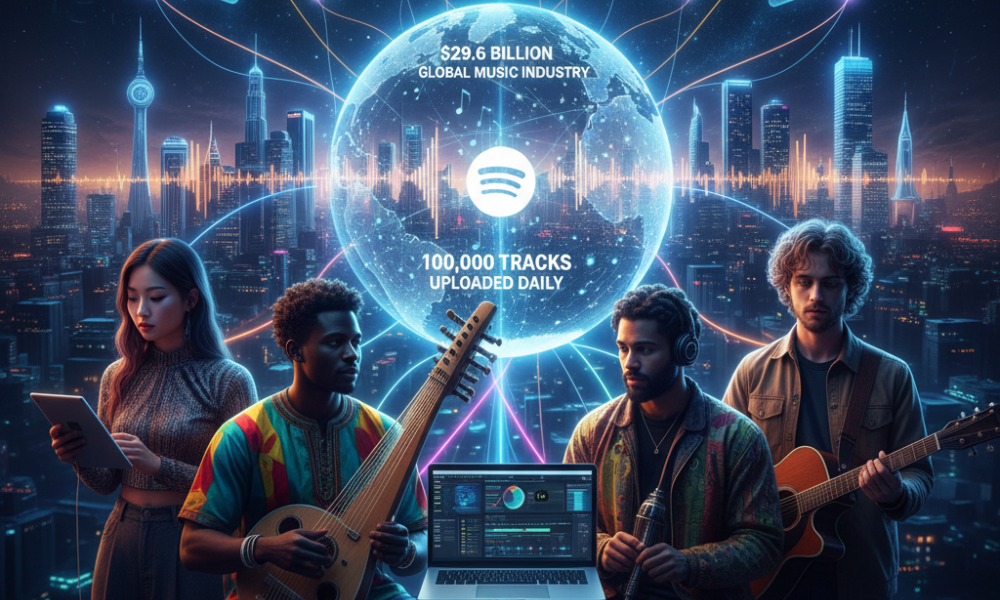
In 2024, the global recorded music industry hit $29.6 billion in revenue, marking its tenth consecutive year of growth. But buried in that headline number is a more striking statistic: while Taylor Swift dominated with 26.6 billion streams, millions of independent artists worldwide are discovering that the real battleground isn’t radio anymore—it’s playlist placement.
The math is stark. Only 274,000 artists generated more than $1,000 in Spotify royalties in 2024, while more than 11.7 million uploaders earned less than that. But for those who crack the code—from bedroom producers in Ohio to Afrobeats artists in Lagos—the rewards can be transformational. The question isn’t whether playlist strategy works—it’s whether most indie artists understand how the game is actually played.
The New Gatekeepers: Playlist Curators & Algorithms
The traditional gatekeepers—A&R executives and radio programmers—have been replaced by the algorithmic corridors of streaming platforms. Today, music discovery is driven by playlist curators who wield immense influence. Spotify’s Fresh Finds playlists, for example, are a major source of new listeners, with 70% of streams coming from fans hearing an artist for the first time.
This shift has created the “playlist economy”—a complex ecosystem where data optimization, strategic timing, and relationship-building determine which of the 100,000 daily track uploads get heard. While this system is more democratic in theory, it requires a new set of skills that most musicians were never taught. Artists today, whether they’re producing K-pop in Seoul or Amapiano in Cape Town, must navigate a complex digital landscape to succeed.
ALSO READ: Stonebwoy A Shining Star in Ghanaian Music and Beyond
Mastering the Seven-Day Window for Editorial Pitches ⏳
Forget A&R executives in corner offices. Today’s music discovery happens in the algorithmic corridors of streaming platforms, where playlist curators wield unprecedented influence over which songs reach millions of ears across continents. Spotify’s Fresh Finds playlists alone helped 70% of streams represent listeners discovering artists for the first time in 2024—whether those artists hailed from Nashville, Stockholm, or Johannesburg.
This shift has created what industry insiders call the “playlist economy”—a complex ecosystem where strategic timing, data optimization, and relationship building determine which of the 100,000 tracks uploaded to Spotify daily actually get heard. The traditional music industry gatekeeping system has been replaced by something more democratic in theory but arguably more complex in practice.
Independent artists now have direct access to the same distribution channels as major labels, but success requires understanding systems that most musicians were never taught to navigate—regardless of whether they’re producing K-pop in Seoul or Amapiano in Cape Town.
The Seven-Day Window That Changes Everything
Here’s where strategy separates the winners from the noise: Spotify’s editorial team only accepts pitches for unreleased music, and submissions must be made at least seven days before the release date through Spotify for Artists. Miss that window, and your track joins the massive pile of already-released music competing for attention without editorial consideration.
But timing isn’t just about meeting deadlines. Industry data suggests that certain submission patterns increase acceptance rates, though Spotify keeps its specific algorithms closely guarded. What successful indie artists have discovered through trial and error—from London drill producers to Nigerian Afrobeats singers—is that the pitch itself needs to solve a curator’s fundamental problem: finding music that matches their playlist’s specific vibe and audience engagement patterns.
The most effective pitches read less like promotional copy and more like briefing documents. Successful artists describe their track’s emotional arc, identify specific placement opportunities within existing playlists, and provide context that helps curators instantly understand where the song fits in Spotify’s vast musical landscape.
How Global Success Stories Are Emerging
The explosion of international genres demonstrates how playlist strategy can amplify reach far beyond traditional geographic boundaries. Asake emerged as 2024’s most streamed artist in Sub-Saharan Africa on Spotify, while royalties to Nigerian artists more than doubled to $37.8 million, but these successes illustrate a broader global trend affecting artists worldwide.
From the 13.5 billion Afrobeats streams on Spotify in 2022 to the rise of Latin trap and K-pop’s continued dominance, playlist placement has become the great equalizer. Artists who master this system can compete globally regardless of their home market size or traditional industry connections.
The streaming revolution has made music globally accessible, but playlist strategy ensures it gets globally discovered. This is particularly evident in emerging markets, where The Music Streaming market in Africa is projected to grow by 7.71% through 2027, reaching $513.20 million and creating new opportunities for artists worldwide to tap into expanding listener bases.
ALSO READ: Burna Boy Earns Icon Status on 2024 TIME100 List of the Most Influential People in the World
Beyond the Pitch: The Global Engagement Game
Getting playlisted is only the opening move. The real game begins once your track appears in someone’s curated selection. Streaming algorithms monitor engagement metrics obsessively—skip rates, save rates, how often listeners return to the song, and whether it drives them to explore more of your catalog.
This has led to what some observers call “playlist optimization”—indie artists structuring songs specifically to perform well in playlist contexts. That might mean frontloading the hook, crafting intros that immediately signal genre and mood, or even adjusting song lengths to align with typical listening patterns across different cultural contexts.
The most sophisticated independent artists now approach releases like product launches, coordinating social media campaigns, fan engagement drives, and cross-platform promotion to create momentum that streaming algorithms interpret as organic popularity.

The Distribution Foundation
While playlist strategy provides the targeting mechanism, effective distribution ensures artists can compete on equal footing with international releases. Modern distribution services have democratized access to global streaming platforms, allowing independent artists to upload their music to Spotify, Apple Music, and other major services simultaneously across all international markets.
This technical infrastructure has proven essential as artists worldwide capitalize on streaming growth. The combination of strategic playlist targeting and comprehensive distribution creates what successful artists describe as “global-local” positioning—music that celebrates cultural identity while maximizing international accessibility.
Whether you’re an indie rock band in Manchester or an Amapiano producer in Pretoria, the fundamental challenge remains the same: getting your music in front of the right curators at the right time with the right context.
ALSO READ: Throwback To 10 Most Popular Davido Songs
The Network Effect Across Borders
While anyone can submit to Spotify’s editorial team, the artists seeing consistent playlist success understand that relationships matter globally. This doesn’t mean pay-to-play schemes—which violate streaming platforms’ terms of service—but rather building genuine connections within the international music ecosystem.
Successful indie artists on Spotify engage with playlist curators on social media, support other musicians in their genres, and approach playlist strategy as community building rather than transactional marketing. They collaborate with other artists not just creatively but strategically, sharing insights about which playlists are accepting submissions and what kinds of pitches are working across different markets.
Some have formed informal international networks, with artists from different continents sharing information about curator preferences, optimal submission timing, and cross-promoting each other’s releases to increase the overall engagement signals that algorithms track.
The Democratization Paradox
The playlist economy has created an interesting global paradox: music discovery is more democratized than ever, yet success increasingly requires sophisticated digital marketing skills that many musicians lack. Independent artists who master these systems can bypass traditional industry gatekeepers entirely, building substantial audiences and generating meaningful revenue without label support—whether they’re based in Los Angeles or Lagos.
But the complexity of the system also means that raw musical talent, while still essential, isn’t sufficient for streaming success. Today’s indie artists must be part musician, part data analyst, part community manager, and part strategic marketer.
The artists thriving in this environment aren’t necessarily the most talented musicians, but they’re the ones who’ve learned to speak the language of the streaming economy fluently across cultural and geographic boundaries on Spotify.
Looking Forward
As streaming platforms continue evolving their discovery mechanisms, the playlist economy will likely become even more sophisticated. Artificial intelligence is already beginning to influence which songs get recommended to human curators, and new playlist formats are emerging that blend algorithmic and editorial curation.
For independent artists willing to treat music as both art and strategic communication, the playlist economy offers unprecedented opportunities to reach global audiences without traditional industry infrastructure. The challenge isn’t just making great music—it’s understanding how to present that music in ways that both human curators and algorithmic systems recognize as worthy of amplification.
In a landscape where millions of songs compete on Spotify for attention daily across every continent, that fluency might be just as valuable as perfect pitch. The streaming revolution has made the world’s music globally accessible—playlist strategy ensures it gets globally discovered.