


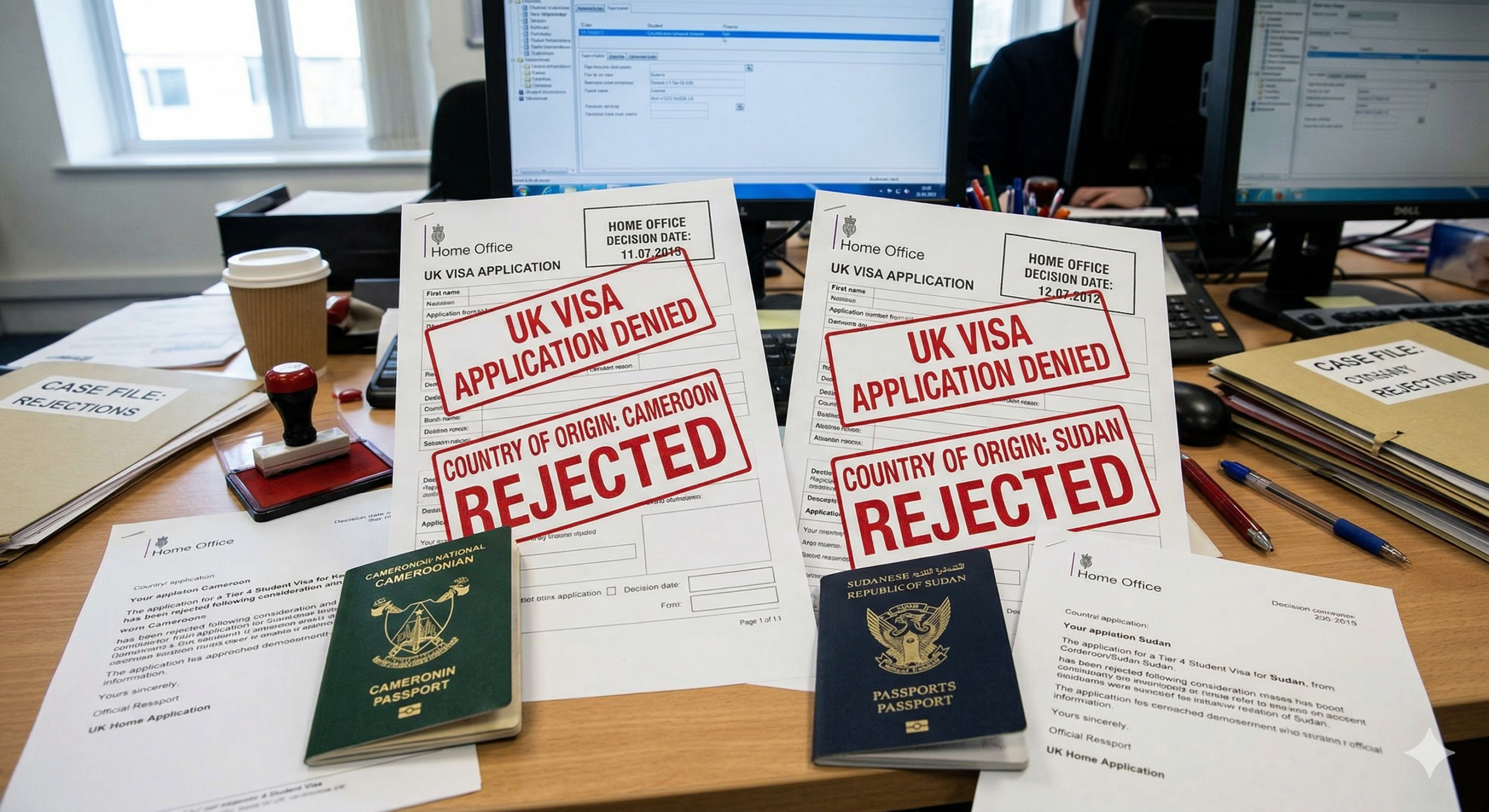
The United Kingdom has introduced a sweeping new immigration measure that has abruptly cut off student visa access for nationals of Afghanistan, Cameroon, Myanmar, and Sudan, a decision that has drawn sharp reactions from affected students, universities, and migration experts alike.
What is the “visa brake”?
The visa brake is a new executive power allowing UK ministers to suspend specific visa routes for nationals of designated countries when they determine there is “widespread abuse” of the immigration system. Under the measure, which took effect for online applications submitted on or after 26 March 2026:
- Student visa applications from Afghan, Cameroonian, Myanmarese, and Sudanese nationals are now refused by default.
- Skilled Worker visa applications from Afghan nationals face the same blanket refusal.
- This applies even to applicants who fully meet all other eligibility requirements.
The Home Office has stated the brake will be reviewed periodically and can be lifted, but has not published specific benchmarks or a timeline for doing so.
ALSO READ: 10 African Universities That Dominate Global Rankings in 2025 🌍
The government’s stated justification rests on official data showing a steep rise in asylum claims filed by student visa holders from the four listed countries. Afghan applicants are cited as a particularly acute example, with authorities claiming that nearly all Afghan student visa holders eventually filed for asylum. Figures for Cameroon, Myanmar, and Sudan reportedly show similar multi-fold increases. Ministers frame the brake as a temporary but necessary measure to “restore control” to a system they describe as being exploited.
The human cost
For the students directly affected, however, the measure has landed as an abrupt and deeply personal disruption.
In Cameroon, where a UK education has long carried significant social and professional prestige, many families spend years pooling finances to cover overseas tuition deposits and living expenses. Students who had already secured offers now face the prospect of forfeited deposits, abandoned plans, and an uncertain wait.
The impact on Sudanese students has drawn particular attention, arriving as it does against the backdrop of an ongoing war and humanitarian crisis at home. The Guardian reports that more than 200 Sudanese postgraduate applicants, some holding confirmed places at institutions including Oxford, Imperial College London, and Queen Mary University of London, now risk losing those opportunities. Among them is molecular biologist Wijdan Abdallah Salman Ahmed, who had secured a place on a regenerative medicine master’s programme at Queen Mary. She described the suspension as a “shock,” saying that years of preparation had collapsed overnight.
A policy with broader consequences
Beyond individual cases, the visa brake raises wider questions about the UK’s positioning as a destination for international talent, particularly from Africa.
Universities have already begun advising affected students to seek alternatives. Oxford Brookes University and the University of Surrey are among institutions that have published guidance confirming they can no longer sponsor new students from the four countries for the duration of the brake, directing offer holders to consult international student advisers about deferrals or alternative destinations.
Critics, including student rights groups and legal experts, are questioning whether a blanket country-level suspension is a proportionate response and whether it could be challenged on equality or human rights grounds. They argue the measure punishes legitimate applicants for the actions of others who share only a passport.
Supporters of the policy counter that the data on asylum conversion rates is significant enough to warrant intervention, and that maintaining the integrity of the visa system benefits lawful applicants in the long run. They point to the government’s stated willingness to review and lift the brake as evidence that it is not intended as a permanent closure.
How students and diaspora communities are responding
Across affected communities, two broad response patterns are emerging. Some are pursuing advocacy, pushing back on the policy through public statements, legal inquiries, and pressure on university administrators and lawmakers. Others are rapidly pivoting to alternative destinations, with Canada, continental Europe, and intra-African hubs such as South Africa, Rwanda, and Mauritius increasingly cited as fallback options.
Diaspora families who had been supporting applications financially are now reassessing whether to fund a redirect or wait out the uncertainty. And for scholarship bodies and academic institutions that plan investments across multiple years, the ability of UK policy to shift overnight for specific passport holders presents a structural planning problem that extends well beyond this particular cohort of applicants.
Longer-term implications for African higher education
Whether or not the brake is short-lived, its timing coincides with, and may accelerate, a broader realignment already underway in how African students approach international education.
Regional universities and centres of excellence are gaining credibility in fields ranging from fintech to public health. Pan-African and South-South academic partnerships with institutions in Asia, the Middle East, and Latin America are expanding. And the very unpredictability that the brake has introduced may strengthen the case, for some families and scholarship bodies, for building careers closer to home rather than assuming a long-term migration path abroad.
What to watch
Three questions will determine how this story develops:
- Transparency on criteria. Will the UK government publish clear, measurable benchmarks for lifting the brake? Without them, affected students cannot make informed decisions about whether to wait or move on, and universities cannot plan their international recruitment with any confidence.
- Institutional pushback. How forcefully will universities and research bodies respond, particularly over the loss of scientists and postgraduates from Sudan and Cameroon? If leading institutions make enough noise, ministers may face a harder political calculation than they currently anticipate.
- Africa’s response. Will African governments and academic institutions seize the moment by investing in scholarships, regional centres of excellence, and partnerships designed to welcome displaced talent? The countries most affected have an opportunity to reframe a setback as a stimulus for building home-grown capacity.
For now, the students caught in the middle are left weighing their options with little clarity on what comes next.